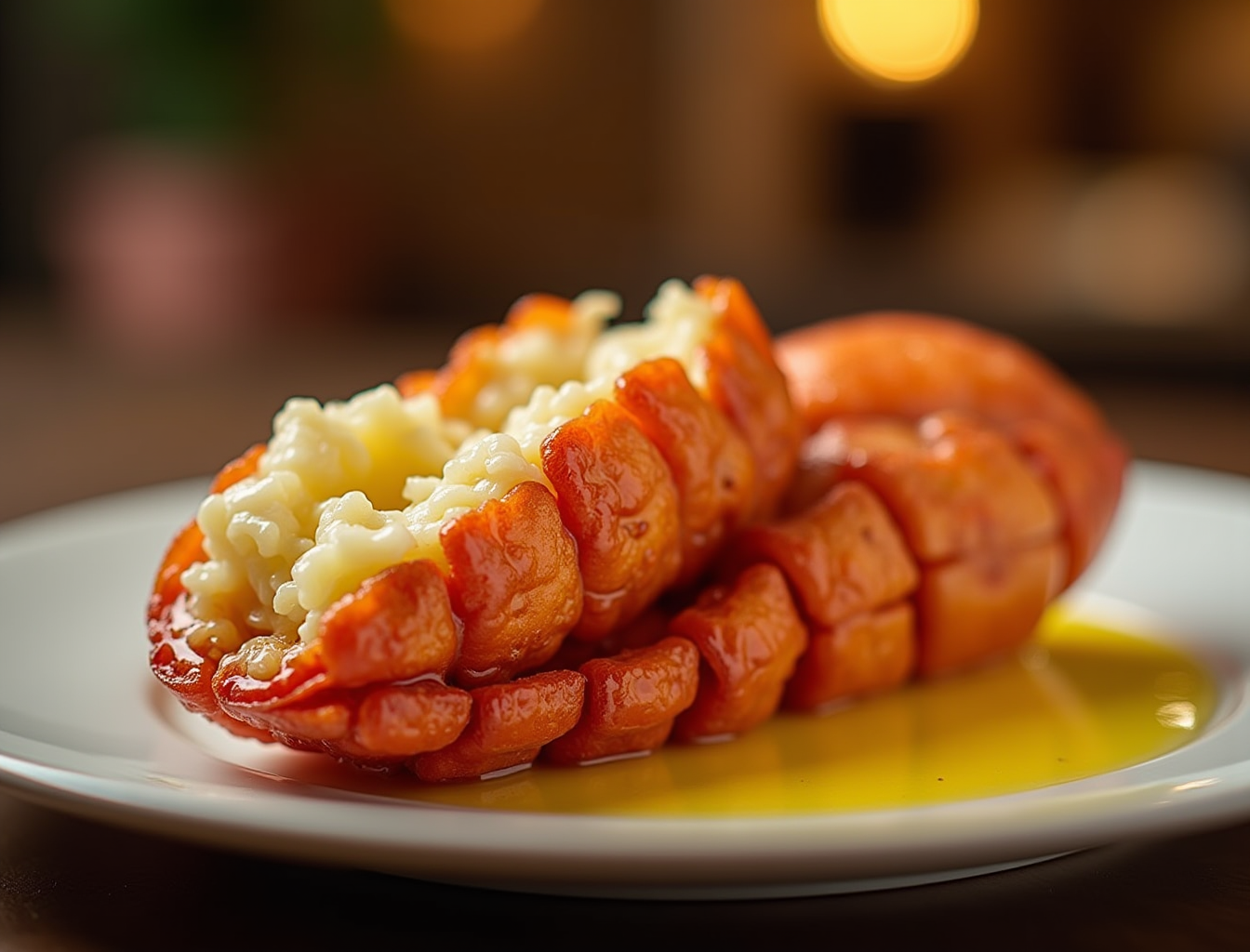
Air Fryer Lobster Tail — Perfectly Cooked Every Time (Butter Garlic Recipe)
Lobster tail has one enemy: overcooking. Push it past the threshold and the meat turns from silky and sweet into something closer to a rubber band. The challenge at home is that most cooking methods — broiling, grilling, boiling — require constant monitoring because the margin between perfectly done and overcooked is measured in minutes, not degrees of error.
PrintAir Fryer Lobster Tail
Butterflied lobster tails cooked in the air fryer with a compound garlic butter that bastes the meat as it cooks, producing tender, juicy results with minimal overcooking risk.
- Prep Time: 10 minutes
- Cook Time: 8 minutes
- Total Time: 18 minutes
- Yield: 2 servings 1x
- Category: Dinner
- Method: Air Fryer
- Cuisine: American
Ingredients
- Lobster Tails:
- 2 lobster tails, 6 oz each (fresh or fully thawed from frozen)
- Compound Garlic Butter:
- 3 tbsp unsalted butter, softened to room temperature
- 2 garlic cloves, minced finely (or pressed through a garlic press)
- 1 tbsp fresh lemon juice
- 1/2 tsp paprika (sweet or smoked)
- Salt and black pepper to taste
- Finishing and Serving:
- 1/4 tsp garlic powder
- Fresh parsley, chopped
- Lemon wedges
- Extra butter, melted, for dipping (optional)
Instructions
- Thaw lobster tails if frozen: refrigerator overnight is ideal. If pressed for time, place tails (still in sealed packaging) under cold running water for 30 minutes. Do not thaw at room temperature or in warm water.
- Butterfly each tail: using kitchen shears, cut straight down the center top of the shell from the wide end toward the tail fan, stopping before the fan. Use a knife to finish the cut through the meat without cutting the bottom shell. Spread the two shell halves apart and push the meat upward to sit on top of the split shell.
- Make the compound garlic butter: mix softened butter with minced garlic, lemon juice, paprika, salt, and black pepper until well combined.
- Season the exposed lobster meat with garlic powder, salt, and pepper. Spread the compound garlic butter generously over the meat.
- Place the butterflied tails meat-side up in the air fryer basket. Cook at 380°F (193°C) for 8 minutes for 6 oz tails, or until the meat is opaque and reaches an internal temperature of 140–145°F.
- Remove from the air fryer, garnish with chopped fresh parsley, and serve immediately with lemon wedges and melted butter for dipping.
Notes
For best results, use cold-water lobster tails (Maine, Canadian, or New Zealand) — they have firmer, sweeter meat than warm-water varieties.
Adjust cook time by tail size: 4 oz tails need about 5–6 minutes; 8 oz tails need about 10–11 minutes. Always verify doneness with an instant-read thermometer.
Frozen IQF (individually quick frozen) tails perform identically to fresh when properly thawed overnight in the refrigerator.
The air fryer solves this problem. Its controlled, consistent circulating heat is gentler than a screaming oven broiler and more precise than a pot of boiling water. With a definitive size-based timing chart and a compound garlic butter that bastes the meat as it cooks, this method works for a 4 oz tail from the grocery store on a Tuesday and an 8 oz cold-water tail from the seafood market on a special occasion.
Why Does the Air Fryer Work Better Than You’d Expect for Lobster Tail?
The Challenge of Cooking Lobster
Lobster tail meat is primarily protein, and proteins denature (tighten and become firm) progressively with heat. At the right temperature, the proteins set into a tender, silky structure. A few degrees higher and they over-tighten into something chewy and rubbery. Unlike chicken, which has a wide margin of forgiving temperatures, lobster has a narrow window where it is both safe and at its best.
How the Air Fryer’s Consistent Temperature Helps
The air fryer’s thermostat-controlled heat maintains a consistent temperature throughout the cooking chamber. There is no hot spot directly above a broiler element, no temperature drop when you open the oven door, no uneven heat from one side of a grill grate. The circulating air delivers even heat to every part of the tail, which means the meat reaches its target temperature uniformly rather than cooking fast on the outside while the center lags behind.
Compared to Other Methods
| Method | Result Quality | Overcooking Risk | Complexity |
|---|---|---|---|
| Air fryer | Excellent — tender, juicy, garlic butter infused | Low with timer | Easy |
| Oven broil | Good — some browning on top | High — unpredictable broiler output | Moderate |
| Boiling | Decent — no browning or butter flavor in meat | Moderate | Easy |
| Steaming | Good — gentle, preserves sweetness | Low | Moderate |
| Grilling | Excellent — best char marks | High — direct heat is unforgiving | High — requires attention |
How Do You Buy the Best Lobster Tails?
Fresh vs. Frozen — Honest Comparison
Unless you live near a working lobster dock or a reputable seafood market with daily fresh deliveries, frozen lobster tails are almost always the better choice for home cooks. They are frozen immediately after harvest to peak freshness, whereas “fresh” lobster tails at most inland grocery stores have typically been in transit or refrigerated display for several days.
High-quality frozen tails sold individually quick frozen (IQF) perform identically to fresh when properly thawed. Thaw overnight in the refrigerator — never at room temperature or in warm water.
Cold Water vs. Warm Water Lobster Tails
This distinction matters significantly and is rarely explained on store labels. Cold-water lobster tails come from Maine, Canada, or New Zealand. They have firmer, whiter, sweeter meat with cleaner flavor. Warm-water lobster tails come from the Caribbean, Florida, and South America. They have softer, sometimes mushier meat with a more pronounced iodine flavor that many people find less appealing.
Look for “Maine lobster,” “Canadian lobster,” or “New Zealand rock lobster” on the package. Whole Foods, Costco, and seafood markets typically carry cold-water product. Grocery store “lobster tails” at $6–8 apiece are almost certainly warm-water.
Size Guide: What to Expect Per Serving
- 4 oz tail: About 2 oz of meat. A light appetizer or part of a surf-and-turf plate.
- 6 oz tail: About 3 oz of meat. A generous appetizer or a light entrée.
- 8 oz tail: About 4 oz of meat. A full entrée portion for one person.
- 10–12 oz tail: Restaurant “split tail” size. A showstopping special occasion portion.
How to Butterfly a Lobster Tail Step-by-Step
Tools You Need
- Kitchen shears (sharp — this is the key tool)
- Chef’s knife or paring knife
- Cutting board
The Butterfly Cut Explained
- Place the lobster tail shell-side up on a cutting board, with the fan (tail fin) pointing away from you.
- Using kitchen shears, cut straight down the center top of the shell from the wide end toward the tail fan. Stop before you cut into the fan — do not cut through the fan section.
- Continue the cut through the meat itself if the shears reach, or use a knife to complete the cut through the meat without cutting the bottom shell.
- Flip the tail over. With both thumbs, spread the two halves of the cut shell apart. Work your thumbs under the meat and push it upward through the shell opening, pulling it up to sit on top of the split shell. The meat is now sitting above the shell — this is the “butterfly” presentation.
- Pull any leftover shell membrane away from the sides of the meat.
Why Butterflying Matters for Even Cooking
Butterflying exposes the thick center of the tail meat directly to the air fryer’s circulating heat. When the tail is left unbutterflied, the shell insulates the bottom of the meat and the thick center takes longer to cook than the thin edges, leading to uneven doneness. The butterfly presentation ensures the compound butter bastes the meat directly throughout cooking, infusing flavor that you simply cannot achieve when the meat is sealed inside the shell.
Ingredients for Air Fryer Lobster Tail with Garlic Butter
Prep time: 10 minutes | Cook time: 8 minutes | Total time: 18 minutes | Serves: 2 (one 6 oz tail each)
The Lobster Tails
- 2 lobster tails, 6 oz each (fresh or fully thawed from frozen)
Compound Garlic Butter
- 3 tbsp unsalted butter, softened to room temperature
- 2 garlic cloves, minced finely (or pressed through a garlic press)
- 1 tbsp fresh lemon juice
- 1/2 tsp paprika (sweet or smoked)
- Salt and black pepper to taste
Finishing and Serving
- 1/4 tsp garlic powder for seasoning the meat
- Fresh parsley, chopped
- Lemon wedges
- Extra butter, melted, for dipping (optional)
How to Cook Air Fryer Lobster Tail — Step-by-Step
- Thaw if frozen: Refrigerator overnight is ideal. If pressed for time, place tails (still in sealed packaging) under cold running water for 30 minutes. Do not thaw at room temperature or in warm water — uneven thawing leads to uneven cooking.
- Butterfly the tails using the method described above.
- Make the compound butter: Mix softened butter with minced garlic, lemon juice, paprika, salt, and pepper until combined. It should be spreadable but not melted.
- Season the meat: Sprinkle exposed meat with garlic powder, a pinch of salt, and black pepper.
- Apply compound butter: Spread about half the compound butter over the exposed lobster meat generously.
- Preheat the air fryer to 380°F for 3 minutes.
- Place lobster tails shell-side down in the basket. The shell acts as a natural cradle. Leave at least 1 inch between tails — do not let them touch.
- Air fry at 380°F. For 6 oz tails: 7–8 minutes total. See the size chart below for other sizes.
- Baste at 5 minutes: Open the air fryer and apply the remaining compound butter over the meat. This second basting deepens the flavor and prevents the exposed meat from drying out.
- Check at 7 minutes with an instant-read thermometer. Target internal temperature in the thickest part of the meat: 145°F (the USDA/FDA recommended safe minimum for shellfish). The meat should be completely opaque white with no translucency.
- Rest 2 minutes before serving. Lobster tail continues cooking slightly from residual heat — resting lets this process complete and allows juices to redistribute.
- Serve with lemon wedges, fresh parsley, and additional drawn butter for dipping.
Air Fryer Lobster Tail Time by Size — The Definitive Chart
| Tail Size | Temperature | Cook Time | Target Internal Temp | Visual Cue |
|---|---|---|---|---|
| 4 oz | 380°F | 5–6 min | 145°F | Fully opaque, shell bright red |
| 6 oz | 380°F | 7–8 min | 145°F | Opaque throughout, edges golden |
| 8 oz | 380°F | 9–10 min | 145°F | Check at 9 min; center must be opaque |
| 10–12 oz | 380°F | 12–14 min | 145°F | Baste at 7 min and 11 min; verify with thermometer |
These times assume butterflied tails placed shell-side down. Adjust by 1–2 minutes for oven-style air fryers, which run slightly cooler than basket models. Always verify doneness with an instant-read thermometer. See our Air Fryer Cooking Times Chart for seafood timing across all appliance types.
How Do You Know When Lobster Tail Is Done?
Internal Temperature: The Definitive Answer
The USDA Food Safety and Inspection Service and the FDA’s seafood safety guidelines both specify 145°F as the safe minimum internal temperature for all shellfish, including lobster. This is the temperature at which harmful pathogens including Vibrio parahaemolyticus and Vibrio vulnificus are reliably destroyed.
Measure in the thickest part of the meat — typically the center of the tail, not near the shell or at the edge where the meat is thinner. A 145°F lobster tail is properly cooked: tender, opaque, and still juicy. Many professional chefs pull lobster at 138–140°F and allow carryover cooking during the rest period to bring it to 145°F — this is a valid technique if you have a reliable thermometer and are comfortable with it.
Visual Cues When You Don’t Have a Thermometer
Two reliable visual cues: (1) the shell has turned bright red/orange from its raw greenish-brown color, and (2) the meat is completely opaque white throughout — cut into the thickest part and check that there is no translucent or gray-white flesh in the center. If the center is still translucent, return to the air fryer for 1–2 more minutes.
The Common Mistake: Cooking to 165°F
165°F is the safe temperature for poultry — chicken breast, ground turkey. Applying this standard to lobster produces an overcooked, rubbery, tough result. Lobster protein denatures at lower temperatures than poultry and does not require 165°F to be safe. The FDA and USDA specify 145°F for seafood including shellfish. Cooking to 165°F is not a safety improvement — it is overcooking.
Garlic Butter Sauce — 3 Versions
Classic Garlic Lemon Butter
3 tbsp butter + 2 minced garlic cloves + 2 tbsp lemon juice + 1 tbsp parsley. Melt butter, cook garlic 60 seconds, add lemon and parsley. The standard — clean, bright, complements the lobster’s sweetness.
Brown Butter with Fresh Thyme
Melt 4 tbsp butter in a light-colored pan over medium heat. Watch and swirl constantly as the milk solids brown and develop a nutty aroma — about 3–4 minutes. Remove from heat immediately, add 4 fresh thyme sprigs and a squeeze of lemon. The brown butter’s nuttiness is a sophisticated contrast to sweet lobster meat. Use as a finishing drizzle rather than a basting sauce.
Cajun Compound Butter
Mix 3 tbsp softened butter with 1 tsp Cajun seasoning, 1/4 tsp cayenne, and 1 tbsp lime juice instead of lemon. Use as the basting butter during cooking. Serve with lime wedges. The spice cuts through the richness of the lobster meat.
What Are the Pro Tips for Perfect Air Fryer Lobster Tail?
Shell-Side Down Is the Correct Orientation
The shell acts as a natural cradle that holds the butterfly-cut meat in place and prevents it from curling under heat. It conducts heat from below while the circulating air cooks the top. If you place the tail meat-side down, it cooks unevenly and the meat cannot be basted from above during cooking. Shell-side down, always.
Baste at the Halfway Point
The first application of compound butter before cooking begins to melt and drip off into the basket as the tail cooks. The halfway baste re-coats the meat with fresh butter and adds flavor depth that builds throughout the second half of cooking. Open the air fryer quickly to minimize temperature drop and apply butter generously with a pastry brush.
Let It Rest 2 Minutes Before Serving
Two minutes of resting allows the internal temperature to equilibrate and any carry-over cooking to finish. It also lets the juices that were driven to the surface redistribute back into the meat. Serving immediately off the heat risks cutting into a tail that is still uneven in temperature and has less succulent texture than a rested one.
Thaw Completely Before Cooking
Partially frozen tails cook unevenly — the outside overcooks while the center struggles to thaw and reach safe temperature. There is no acceptable workaround for cooking from frozen. Plan ahead and thaw in the refrigerator. If you forgot: cold running water for 30 minutes works well and does not begin to cook the exterior as warm water would.
What Are the Best Variations for Air Fryer Lobster Tail?
Old Bay Lobster Tail
The compound butter recipe is identical except: replace paprika with 1.5 tsp Old Bay seasoning and add 1/4 tsp dry mustard. Old Bay’s blend of celery salt, bay leaf, mustard seed, and cayenne is an East Coast classic pairing with shellfish. Serve with corn on the cob and boiled potatoes for a New England-style summer plate.
Herb Panko Crust
Mix 2 tbsp panko breadcrumbs with 1 tbsp grated parmesan, 1 tbsp softened butter, 1 tsp fresh thyme, 1 tsp fresh chives, salt, and pepper. Spread over the top of the butterflied lobster meat before cooking (in addition to the compound butter underneath). Air fry at 375°F for 8–9 minutes until the crust is golden and the meat underneath is opaque. The crunchy topping contrasts with the silky meat.
Surf and Turf
Pair a 4–6 oz lobster tail with a small filet mignon or NY strip. Cook the steak in the air fryer first (it needs higher heat and more time), then rest the steak while the lobster cooks. The timing works cleanly: steak at 400°F for 12–14 minutes (medium-rare), rest 5 minutes while lobster cooks at 380°F for 7–8 minutes. Serve together. See our Air Fryer Steak guide for the full steak method.
What to Serve With Lobster Tail?
Classic Sides
- Drawn butter: Clarified butter with lemon — mandatory
- Corn on the cob: See our Air Fryer Corn on the Cob recipe for perfectly charred corn
- Baked potato with all the toppings
- Caesar salad: The richness of lobster needs something acidic and crisp alongside it
Elevated Sides
- Asparagus: Quick-cook in the air fryer while the lobster rests — see our Air Fryer Asparagus recipe
- Risotto: Parmesan risotto or saffron risotto pairs beautifully with lobster’s sweetness
- Champagne beurre blanc: Reduce champagne and shallots, mount with cold butter — an elegant sauce that elevates the occasion
How Do You Store and Reheat Air Fryer Lobster Tail?
Cooked lobster tail keeps in the refrigerator for 1–2 days maximum. Lobster quality degrades faster than most shellfish — after 48 hours, the texture becomes less cohesive and the flavor flattens.
Best reheat method: Remove the meat from the shell if possible. Brush with butter, wrap loosely in foil, and heat in the air fryer at 300°F for 4 minutes. Low and slow prevents the proteins from over-tightening. Higher temperatures (375°F or above) will turn reheated lobster rubbery.
Best use for leftovers: Cold cooked lobster tail in a lobster roll, over pasta with butter and lemon, or in a salad with avocado and citrus vinaigrette. Cold applications preserve the texture better than reheating.
Do not freeze cooked lobster. Freezing breaks down the cellular structure of cooked lobster meat, resulting in a mushy, waterlogged texture when thawed.
Frequently Asked Questions
What temperature should air fryer lobster tail reach when done?
According to USDA and FDA seafood safety guidelines, lobster tail should reach an internal temperature of 145°F in the thickest part of the meat. At 145°F, the meat is opaque white, tender, and fully safe to eat. Many professional chefs remove lobster from heat at 138–140°F and allow carryover cooking during resting to bring it to 145°F — this is acceptable as long as you verify the final temperature reaches 145°F before serving.
How long do you cook lobster tail in the air fryer?
Cooking time depends on the size of the tail at 380°F: 4 oz tails take 5–6 minutes, 6 oz tails take 7–8 minutes, 8 oz tails take 9–10 minutes, and 10–12 oz tails take 12–14 minutes. Always verify with an instant-read thermometer — lobster tail size varies between suppliers and internal temperature is more reliable than time alone.
Can you cook frozen lobster tail in the air fryer without thawing?
Not recommended. Frozen lobster tails cook unevenly — the exterior overcooks before the frozen center reaches a safe temperature. Thaw overnight in the refrigerator, or under cold running water for 30 minutes in the sealed bag. Fully thawed tails cook evenly and produce a far superior result.
What is the difference between cold-water and warm-water lobster tails?
Cold-water lobster tails (from Maine, Canada, or New Zealand) have firmer, whiter, sweeter meat with clean flavor. Warm-water lobster tails (from the Caribbean and South America) have softer, sometimes mushier meat with a stronger iodine flavor. Cold-water tails cost more but the texture and flavor difference is significant. Look for the origin on the package.
Why did my lobster tail come out rubbery?
Rubbery lobster is overcooked lobster. The three most common causes: (1) cooking to 165°F (the poultry temperature — far too high for shellfish); (2) not accounting for air fryer model variance and running 2–3 minutes over time; (3) cooking from partially frozen, which causes uneven heating and makes the exterior overcook before the center is done. Use a thermometer and pull at 145°F.
Related Recipes
- Air Fryer Cooking Times Chart — Complete Guide (100+ Foods)
- Air Fryer Steak — Perfect Medium-Rare Every Time
- Air Fryer Shrimp — Perfectly Cooked Every Time
- Air Fryer Salmon — Crispy Skin, Tender Center
- Air Fryer Corn on the Cob
- Air Fryer Asparagus
![Air Fryer Shrimp [Crispy, Healthy, 15-Minute Recipe]](https://airfrycentral.com/wp-content/uploads/2026/03/air-fryer-shrimp-768x585.png)