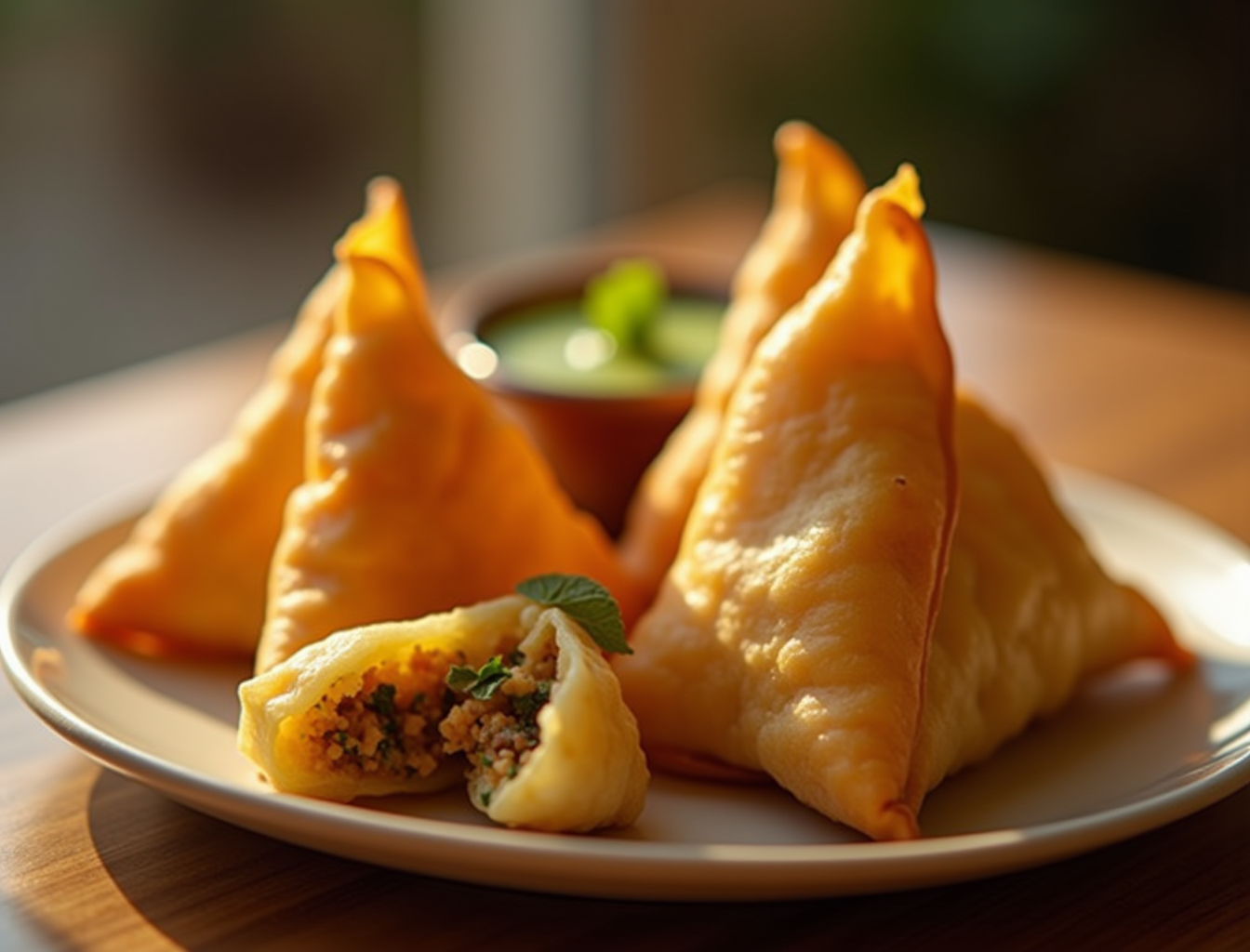
Air Fryer Samosas (Crispy, Golden — From Scratch or Frozen)
The samosa is one of the most widely eaten pastries on earth. Sold from roadside carts in Delhi, tucked into chai shops from Lahore to Nairobi, and stacked in pyramid formations at every South Asian family gathering, the samosa has conquered the snacking world. The obstacle for home cooks has always been the deep-frying: the oil-splattered stovetop, the careful temperature monitoring, and the slightly guilty feeling after eating three in a row.
The air fryer solves all of that. You get the same flaky, shatteringly crisp pastry shell and the same spiced potato-pea filling — with roughly 75% less oil and none of the mess. This guide covers all three scenarios: making samosas from scratch with homemade dough, using store-bought wrappers for a shortcut, and cooking frozen samosas from straight out of the freezer.
Why Are Air Fryer Samosas Better Than Deep-Fried?
The real cost of traditional deep-frying
Classic samosa dough (maida — fine-milled Indian all-purpose flour) is a stiff, unleavened pastry that absorbs oil during deep-frying. A single deep-fried samosa typically carries 150–200 calories, with 8–10 grams of fat — most of it absorbed from the frying oil rather than from the filling. Multiply that by the four or five samosas a normal person eats in one sitting and you’re looking at a significant fat load.
Beyond calories: deep-frying samosas at home requires oil heated to 325–350°F, constant temperature monitoring, and working in batches. The oil needs to be cooled and strained after, or discarded. For a home cook who wants samosas on a Tuesday, this is a significant barrier.
Air fryer results: the same crunch, dramatically less fat
Air-fried samosas achieve the same golden, blister-pocked exterior as deep-fried ones because the cooking mechanism is comparable — rapid surface dehydration from intense heat, just driven by air rather than immersion in fat. The key difference: you brush the pastry with a small amount of oil rather than submerging it. A brushed samosa uses roughly 1 teaspoon of oil total, versus the 3–4 teaspoons absorbed during deep-frying.
| Method | Calories (per samosa) | Fat (g) | Active Time | Mess Level |
|---|---|---|---|---|
| Deep-fried | ~175 | 9–10 g | 20 min (+ oil temp) | High |
| Oven-baked | ~120 | 4–5 g | 25–30 min | Low |
| Air fryer | ~160 | 5–6 g | 15 min | Minimal |
What Are the Three Ways to Make Air Fryer Samosas?
Option 1 — From scratch with homemade dough
The most rewarding approach and the one that produces the best texture. Samosa dough (maida + oil + salt + water) is a stiff, workable pastry that rolls thin without tearing. The stiffness is intentional — a soft, pliable dough will puff, bubble, and potentially tear in the air fryer. Making dough from scratch adds 30 minutes of rest time but only about 10 minutes of active work.
Option 2 — Store-bought empanada discs or puff pastry
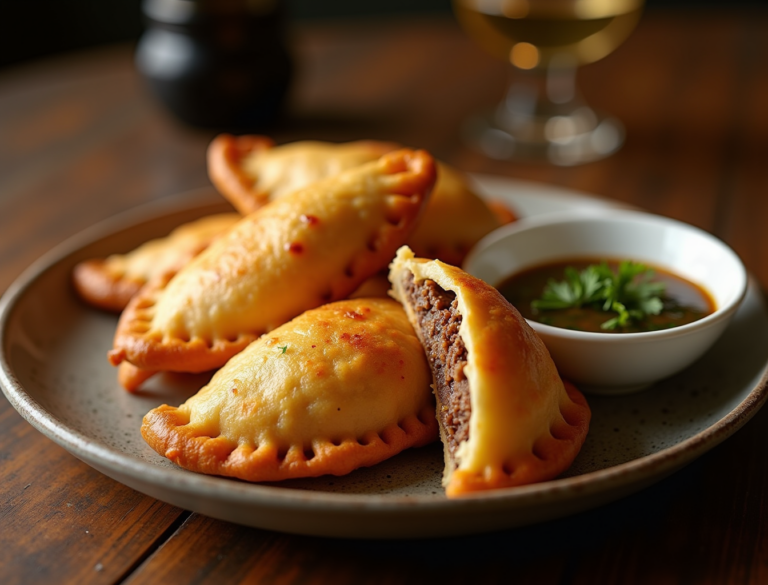
Goya empanada discs make a serviceable samosa shortcut — they’re pre-rolled, uniformly round, and hold up well to the air fryer. The texture is slightly flakier and more buttery than traditional samosa dough (which is more cracker-like), but the results are genuinely good and come together in about 40 minutes total. Puff pastry produces an even flakier, more layered result — closer to a vol-au-vent than a traditional samosa, but delicious in its own right.
Option 3 — Cooking frozen samosas in the air fryer
Frozen samosas (brands like Deep, Haldiram’s, or home-frozen) cook excellently from frozen in the air fryer — and come out crispier than in a conventional oven. No thawing required. The key is starting at a slightly lower temperature (375°F / 190°C) to allow the frozen filling to heat through before the outside over-browns. Most frozen samosas are done in 10–14 minutes depending on size.
What Ingredients Do You Need for Homemade Air Fryer Samosas?
For the dough:
- 2 cups all-purpose flour (maida gives the most authentic texture)
- ¼ cup neutral oil or melted ghee
- ½ tsp salt
- ½ cup warm water (add gradually — you may need slightly more or less)
For the classic potato-pea filling:
- 3 medium potatoes, boiled and roughly mashed (not smooth — chunky texture is key)
- ½ cup green peas (fresh or frozen, thawed)
- 1 tbsp neutral oil
- 1 tsp cumin seeds
- 1 tsp garam masala
- 1 tsp coriander powder
- ½ tsp turmeric
- ½ tsp red chili powder (or to taste)
- 1 tbsp fresh ginger, finely grated
- Salt to taste
- 2 tbsp fresh cilantro, chopped
The spice blend is what distinguishes a great samosa from a merely good one. Cumin seeds tempered in hot oil (tarka) release a toasted, nutty fragrance that permeates the filling. Garam masala provides warmth; coriander and turmeric give depth and color; ginger provides the brightness that keeps the filling from tasting heavy. Use whole cumin seeds (not ground) for the tempering — the texture and flavor are entirely different.
How Do You Make Air Fryer Samosas From Scratch Step-by-Step?
Step 1 — Make and rest the dough
Combine flour, salt, and oil in a bowl. Rub the oil into the flour with your fingertips until the mixture resembles coarse breadcrumbs — this “moyan” technique (as it’s called in Indian baking) is what creates the characteristic flaky layers in samosa pastry. Add warm water tablespoon by tablespoon, mixing until the dough just comes together. It should be stiff — significantly stiffer than bread dough or pizza dough. If it’s soft and pliable, it will puff and blister incorrectly in the air fryer.
Knead for 3–4 minutes until smooth, then cover with a damp cloth and rest for 30 minutes at room temperature. This rest allows the gluten to relax, making the dough easier to roll thin without springing back.
Step 2 — Cook the spiced potato filling
Heat oil in a pan over medium-high. When shimmering, add cumin seeds — they should sizzle immediately (if they don’t, the oil isn’t hot enough). Add grated ginger and cook 30 seconds. Add the dry spices and stir for 20 seconds — this brief toasting deepens their flavor. Fold in the mashed potatoes and peas, season with salt, and cook 2–3 minutes until the mixture is cohesive and slightly dry. Add cilantro, remove from heat, and spread on a plate to cool completely.
The filling must be completely cool — not warm, not room temperature, but fully cooled — before stuffing. Hot filling creates steam inside the sealed samosa, which softens the dough and can force the seams open during cooking.
Step 3 — Roll, fill, and seal the samosas
Divide the dough into 6 equal balls. Roll each into an oval approximately 6 inches long and 4 inches wide. Cut each oval in half crosswise — you now have 12 semi-circles, each of which will form one samosa.
To form the cone: take a semi-circle, bring the two cut-edge corners together to form a cone shape, and seal the seam with flour-water paste (1 tablespoon flour mixed with 1 tablespoon water to form a thick glue — use this, not plain water). The seam needs to be pressed firmly for at least 5 seconds.
Hold the cone in one hand, open end up. Spoon in 2 tablespoons of filling — no more. Seal the top by pressing the edges together firmly, applying more flour-water paste to both edges before pressing. A clean, firm seal with the paste is essential; this seam takes the most stress during cooking.
Step 4 — Brush with oil and air fry at 350°F
Preheat air fryer to 350°F (175°C) for 3 minutes. Brush all surfaces of each samosa with oil using a pastry brush — don’t use a spray here. Spray doesn’t reach into the folded edges and corners, where oil is most needed for browning. Brushing ensures complete, even coverage.
Place in a single layer with space between each. Air fry at 350°F for 12–15 minutes, flipping once at the 8-minute mark and brushing the newly exposed surface with additional oil. The samosas are done when they are deep golden brown all over and the pastry sounds slightly hollow when tapped.
What Is the Air Fryer Samosa Time and Temperature Guide?
| Type | Temperature | Time | Flip? | Notes |
|---|---|---|---|---|
| Homemade (scratch dough) | 350°F (175°C) | 12–15 min | Yes, at 8 min | Brush with oil both sides |
| Store-bought wrappers (Goya discs) | 350°F (175°C) | 10–12 min | Yes, at 6 min | Thinner pastry cooks faster |
| Frozen samosas (pre-made) | 375°F (190°C) | 10–14 min | Yes, halfway | No thawing needed |
| Reheat (cooked samosas) | 350°F (175°C) | 4–5 min | No | Fully restores crispness |
Lower temperature (350°F) for homemade samosas allows the thick dough to cook through without burning the outside. Frozen samosas start at 375°F to help thaw and cook simultaneously.
How Do You Stop Samosas From Opening in the Air Fryer?
The flour-water paste technique
Plain water seals bread and pasta dough because it activates the gluten and creates a bond. For the stiff samosa dough, which has less moisture and less active gluten at the surface, plain water produces a weak seal that fails under the heat and pressure of cooking. Flour-water paste — 1 tablespoon each, mixed to a thick glue consistency — creates a structural adhesive that sets and hardens during cooking. Apply it generously to both surfaces being sealed and press firmly for 5 full seconds.
The cone folding method
The cone method (as opposed to folding the dough flat and crimping) creates a naturally sealed pocket because the cone shape distributes the filling pressure evenly to the sides rather than concentrating it at the seam. When you form the cone first, seal it, then fill and seal the top, you’re creating two separate seams — each under less stress than a single seam that has to bear all the filling pressure.
What Are the Pro Tips for the Crispiest Air Fryer Samosas?
Make the dough stiff, not soft
This is counterintuitive for most Western bakers. Samosa dough should feel firm and slightly dry — closer to pie crust dough than to bread dough. If you can easily deform it with one finger, add more flour. Stiff dough creates the characteristic shatter-crisp samosa shell; soft dough puffs and becomes bready in the air fryer.
Cool the filling completely — not just to room temperature
Make the filling at least 1 hour ahead, or refrigerate it. The filling should be noticeably cool to the touch when you stuff the samosas. Even slightly warm filling contains residual steam that will soften the interior dough and can blow open a seam under cooking pressure.
Brush (do not spray) oil for even coverage
A spray bottle produces a fine mist that doesn’t penetrate the folded edges and corners of a samosa. A pastry brush pushes oil into every crevice, ensuring that every surface — including the edges where multiple layers of dough come together — browns evenly. Pay particular attention to the seam areas, which are thicker and take longer to color.
What Dipping Sauces Go with Samosas?
Mint chutney (classic green chutney)
Blend 1 cup fresh mint leaves, ½ cup fresh cilantro, 1 green chili, 1 garlic clove, 1 tablespoon lemon juice, ½ teaspoon cumin, and 3 tablespoons water until smooth. The cooling herbal freshness cuts through the richness of the potato filling and the slightly oily pastry. This chutney keeps refrigerated for 3 days.
Tamarind chutney (imli chutney)
The sweet-sour-spice complexity of tamarind chutney is the traditional pairing for potato samosas across northern India. Combine 3 tablespoons tamarind concentrate, 2 tablespoons jaggery (or brown sugar), ½ teaspoon cumin powder, ½ teaspoon ginger powder, and a pinch of black salt (kala namak) — the sulfuric note of black salt is what makes it taste like the restaurant version. Thin with water to drizzling consistency.
Yogurt raita
For a cooling, lower-acidity accompaniment, whisk 1 cup full-fat yogurt with ½ teaspoon cumin, a pinch of salt, and chopped cilantro. The yogurt’s creaminess balances the heat of the spiced filling, and the combination is particularly good with keema (meat) samosas.
What Are the Best Samosa Filling Variations?
Keema (spiced minced meat) samosas
Keema samosas are the meaty counterpart to potato samosas and are particularly popular in Pakistan and Bangladesh. Cook ground lamb or chicken with ginger, garlic, garam masala, cumin, and a touch of yogurt until completely dry (wet filling will steam the pastry). Add chopped green chili for heat and fresh cilantro before cooling. The filling must be drier than potato filling — any residual liquid will make the pastry soggy from the inside.
Lentil and spinach samosas
Cook red lentils until very soft, drain thoroughly, and mash. Combine with wilted, finely chopped spinach (squeeze out every drop of water), a tarka of cumin and mustard seeds, and garam masala. This filling is naturally vegan, high in protein and iron, and works beautifully with the mint chutney pairing. The lentil base is stickier than potato, so these samosas seal more easily — good for beginners.
Dessert samosas
Fill with a small piece of Nutella (about 1 teaspoon) and a few slices of banana — seal tightly (the Nutella will melt during cooking and seek out any gaps in the seal). Air fry at 350°F for 10–12 minutes. Dust with powdered sugar and serve immediately. This is not traditional, but it’s the best use of leftover samosa dough you’ll ever find.
How Do You Store, Freeze, and Reheat Air Fryer Samosas?
Cooked samosas keep in an airtight container in the refrigerator for up to 3 days. The pastry softens overnight — this is expected. Reheat in the air fryer at 350°F for 4–5 minutes, which fully restores the crispness. Do not microwave: microwaved samosa pastry becomes soft, chewy, and slightly gummy.
For meal prep, freeze assembled uncooked samosas. Arrange on a parchment-lined tray and freeze until solid (2 hours), then transfer to a freezer bag. Cook from frozen at 330°F for 18–20 minutes, flipping once at the halfway mark and brushing with oil on both sides. Frozen samosas may need 2–3 minutes longer than the fresh version to ensure the filling heats through completely.
Frequently Asked Questions About Air Fryer Samosas
Can you cook frozen samosas in an air fryer?
Yes — air fry frozen samosas at 375°F for 10–14 minutes, flipping once halfway. No thawing needed. They come out crispier than oven-baked and significantly less greasy than deep-fried. Size matters: smaller snack-sized samosas may be done at 10 minutes; larger restaurant-style samosas need closer to 14 minutes.
What temperature and time for homemade air fryer samosas?
Cook at 350°F for 12–15 minutes, flipping at 8 minutes and brushing both sides with oil. The lower temperature (versus 375°F) is intentional: it gives the thick stiff dough time to cook through to the filling without the outside burning. At 375°F, homemade samosa dough tends to brown too fast on the outside while remaining undercooked at the seams.
How do you stop samosas from opening in the air fryer?
Use flour-water paste (not plain water) to seal — mix equal parts flour and water to form a thick glue. Press and hold the seam for 5 seconds. Also ensure the filling is completely cool before stuffing (warm filling creates steam pressure that blows open seams), and never overfill — 2 tablespoons maximum per samosa.
Do you need to brush oil on samosas for the air fryer?
Yes — particularly for homemade samosas. The pastry needs a coating of oil to brown and develop the characteristic shatter-crispy texture. Without oil, the surface dehydrates and turns pale and leathery rather than golden and flaky. Brush (don’t spray) to ensure oil reaches into all the folds and seams.
Can you use puff pastry for air fryer samosas?
Yes — puff pastry samosas are a legitimate shortcut. They produce a different texture (flaky, layered, more buttery) than traditional samosa dough, but are delicious. Use thawed puff pastry, cut into 4-inch squares, fill with 1.5 tablespoons of filling (less than usual — puff pastry puffs and expands), seal with egg wash, and air fry at 350°F for 10–12 minutes until puffed and golden.
For the complete guide to cooking times across all air fryer foods, bookmark the Air Fryer Cooking Times Chart. For more international snacks, try Air Fryer Empanadas or Air Fryer Spring Rolls.
Sources: The Curry Guy | Watch Learn Eat | Sanjana Feasts