Air Fryer Egg Rolls (Crispy Homemade + Frozen Guide)
The crispy, golden egg roll is one of the most recognizable items in American Chinese takeout — and one of the most difficult to replicate at home without a large pot of hot oil. The deep fryer delivers that blistered, crackling exterior because the wrapper is fully submerged in 350°F oil, cooking all sides simultaneously. Oven baking can never replicate this; the indirect heat produces a soft, pale wrapper that bears no resemblance to the real thing.
The air fryer is different. High-velocity circulating air at 390°F reaches every surface of the egg roll at once — all four sides plus the ends — and produces a wrapper that genuinely blisters and crisps. The result uses 75% less oil than deep frying and takes 12 minutes. This post covers both audiences: if you have a bag of frozen egg rolls and want the best time and temperature, jump to the frozen section. If you are making homemade egg rolls from scratch, this is the complete technique guide.
Why Does the Air Fryer Make Better Egg Rolls Than Baking?
The difference between oven-baked and air-fried egg rolls comes down to heat delivery. An oven heated to 375°F transfers heat primarily through radiation (from the heating elements) and conduction (from the rack below). The wrapper gets hot from the bottom and top but remains largely untouched on the sides. The result is a pale, slightly chewy wrapper with two browned faces and two soft sides.
The air fryer’s circulating air surrounds the egg roll from every direction. Every part of the wrapper surface is in continuous contact with hot, fast-moving dry air, which heats all surfaces simultaneously and accelerates evaporation of any moisture in or on the wrapper. This produces the same blistered, golden-brown surface all the way around that deep frying achieves — without submerging in oil. The crunch is genuine; it is not a compromise.
What Ingredients Do You Need for Homemade Air Fryer Egg Rolls?
- 12–14 egg roll wrappers (refrigerated section, near tofu or wonton wrappers)
- 1/2 lb ground pork (or substitute — see variations)
- 2 cups napa cabbage, finely shredded
- 1 cup carrots, shredded (box grater or food processor)
- 3 green onions, thinly sliced
- 3 cloves garlic, minced
- 1 teaspoon fresh ginger, grated
- 2 tablespoons soy sauce
- 1 teaspoon sesame oil
- 1 tablespoon oyster sauce (recommended — adds depth)
- 1 egg, beaten (egg wash for sealing)
- Cooking spray (for the basket and the egg rolls)
Egg roll wrappers vs. spring roll wrappers: These are not interchangeable. Egg roll wrappers are thicker, made with wheat flour and egg, and produce the characteristic blistered, crunchy exterior. Spring roll wrappers are thinner rice paper wrappers that produce a different, more delicate texture. For the deep-fried-style crispy result, use egg roll wrappers specifically. They are stocked in the refrigerated section of most grocery stores near wonton wrappers and tofu.
How Do You Make the Filling for Egg Rolls?
Prep the Vegetables to the Right Size
The shred size matters more than it might seem. Vegetables cut too large create uneven lumps in the wrapper that make rolling difficult and leave raw-textured chunks in the finished egg roll. Napa cabbage should be finely shredded — 1/4-inch-wide strips. Carrots should be grated rather than julienned; the smaller pieces distribute evenly throughout the filling. Green onions should be sliced thin and added last to preserve their brightness.
Cook the Pork and Drain the Fat
Cook ground pork in a dry skillet over medium-high heat, breaking into small crumbles. Cook until no pink remains. Drain all fat completely. This is a non-negotiable step. Fat left in the filling creates steam inside the egg roll during cooking, which softens the wrapper from the inside and prevents the exterior from crisping. Pour off or spoon out every bit of rendered fat after cooking the pork, then set aside to cool.
Stir-Fry the Vegetables Briefly
In the same pan with 1 teaspoon of oil over high heat, stir-fry the cabbage, carrots, garlic, and ginger for 2–3 minutes — just until the cabbage is slightly wilted but still has texture. Do not fully cook the vegetables; they will continue cooking inside the egg roll. Fully cooked cabbage becomes mushy and wet during the air fry step. You want wilted, not soft.
Combine and Season
Combine the cooked pork, stir-fried vegetables, green onions, soy sauce, sesame oil, and oyster sauce in a bowl. Mix well. Taste and adjust — the filling should be savory and well-seasoned, with a distinct soy and sesame note. If the oyster sauce is unavailable, increase the soy sauce by 1/2 tablespoon and add a teaspoon of Worcestershire sauce as a substitute.
Cool Completely — The Non-Negotiable Step
Spread the filling on a large plate or sheet pan and let it cool to room temperature for at least 10 minutes. This is the step most beginner egg roll recipes omit and most experienced cooks emphasize. Hot filling generates steam inside the egg roll during rolling. That steam wets the inside of the wrapper, which weakens the seal and creates sogginess before the egg roll ever enters the air fryer. Cold or room-temperature filling stays dry inside the wrapper until cooking begins, when the heat is ready to drive the moisture out properly.
How Do You Roll Egg Rolls Step by Step?
Orient the Wrapper Like a Diamond, Not a Square
Place the egg roll wrapper on a clean, dry work surface with one corner pointing toward you — oriented like a diamond, not a square. This orientation gives you the natural roll direction and the two side flaps needed for proper folding. Working with the wrapper as a square (one flat edge toward you) makes the fold awkward and produces a boxy shape that does not cook evenly.
Fill — 3 Tablespoons Maximum
Place 3 tablespoons of filling in a horizontal line across the lower third of the wrapper, leaving a 1-inch border at the bottom point. Three tablespoons is the absolute maximum — resist the urge to add more. Overfilling is the number one cause of torn wrappers, blown-out seams, and egg rolls that fall apart in the basket. A tight, compact filling rolls better and cooks more evenly than a stuffed one.
Fold the Sides In First
Fold the left and right corners of the diamond inward over the filling, forming an envelope shape. Hold them in place. This step is what prevents the filling from escaping out the ends during rolling and cooking.
Roll Tight and Seal with Egg Wash
Starting at the bottom point, roll the wrapper tightly away from you, keeping firm pressure so no air pockets form between the wrapper and the filling. Air pockets expand during cooking and cause uneven browning on those sections. When you reach 1–2 inches from the top point, brush the remaining flap generously with beaten egg wash. Finish rolling and press the seam firmly for 5 seconds. The egg wash acts as adhesive. If the seam does not feel secure, add more egg wash and press again. A loose seam will open during cooking and the filling will fall out.
Common Rolling Mistakes
- Starting with the wrapper oriented as a square: Makes the fold awkward and produces a less compact roll
- Overfilling: Causes wrapper tears and seam blowouts
- Loose rolling: Air pockets cause uneven browning and floppy sections
- Insufficient egg wash on the seam: The seam opens during cooking and the filling falls out
- Rolling with hot filling: Steam weakens the wrapper immediately
How Do You Cook Egg Rolls in the Air Fryer?
Prep the Basket
Spray the air fryer basket with a light coat of cooking spray or use a parchment liner with holes punched throughout. This step prevents the egg roll wrapper from sticking to the basket surface during the critical first 3–4 minutes when the wrapper is still soft.
Spray the Egg Rolls on All Sides
Place the egg rolls seam-side down in a single layer in the basket. Using your oil mister or cooking spray, coat all surfaces — top, bottom sides visible, and ends. The seam gets sprayed last. Oil spray is not optional for this recipe. Dry egg roll wrappers in a hot air fryer go tan and leathery rather than golden and blistered. The thin layer of oil is what creates the blistering and deep golden color that distinguishes air-fried from oven-baked.
Cook at 390°F for 8–10 Minutes, Turning Halfway
Air fry at 390°F. At the 5-minute mark, use silicone tongs to turn each egg roll to expose the underside to direct heat. Spray any pale sections lightly with oil. Continue cooking for 4–5 more minutes until golden brown all the way around. The wrapper should look blistered and deeply golden — not pale tan. A visual check at 8 minutes: if the wrapper looks uniformly golden and the seam has baked shut, they are done. If any sections still look pale, add 1–2 minutes.
Visual Doneness Cue
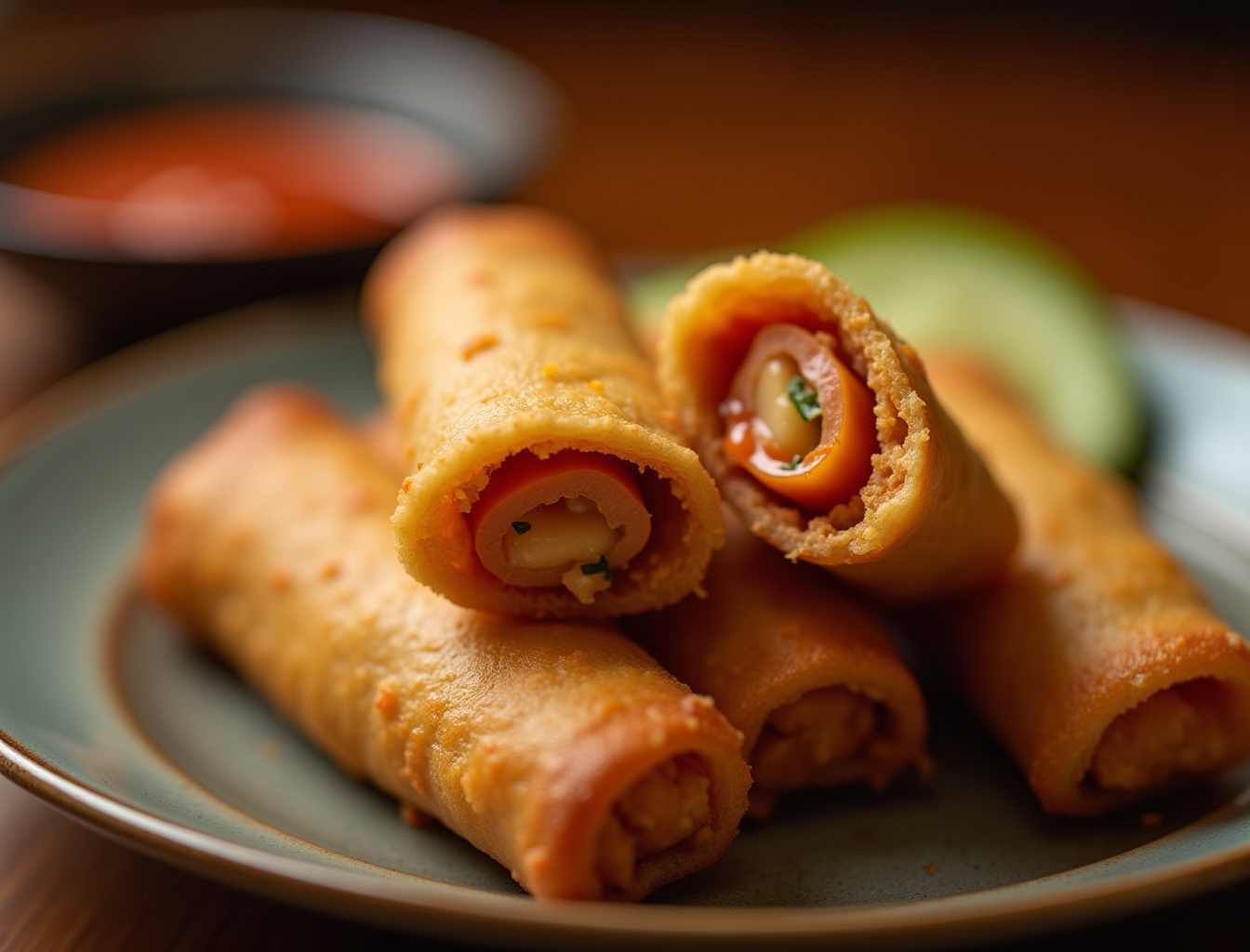
Done egg rolls: deep golden-brown all over, slight blistering on the wrapper surface, seam completely sealed and baked. A small amount of filling visible at the ends is normal and does not indicate a problem. The exterior should look slightly wrinkled and blistered — that texture is what indicates genuine crisping rather than just browning.
Air Fryer Egg Roll Time and Temperature Guide
| Type | Temperature | Time | Notes |
|---|---|---|---|
| Homemade (fresh, just rolled) | 390°F | 8–10 min | Turn at 5 min; spray both sides |
| Homemade (frozen uncooked) | 375°F | 12–14 min | No thaw needed; spray lightly |
| Store-bought frozen (standard) | 390°F | 10–12 min | Shake at halfway; add oil spray |
| Mini egg rolls (frozen) | 390°F | 8–10 min | Shake frequently; smaller size crisps faster |
For complete air fryer cooking times across all foods, see the Air Fryer Cooking Times Chart.
Frozen Egg Rolls in the Air Fryer — Complete Guide
Frozen egg rolls are one of the best applications for the air fryer. They go from freezer to table in 10–12 minutes with a genuinely crispy exterior that the conventional oven cannot match, and they require essentially no effort.
Do you need to thaw frozen egg rolls first? No. Cooking from frozen produces better results than thawing. The cold interior acts as a buffer — while the exterior surface is rapidly heating and crisping at 390°F, the filling heats gradually from the inside out. Thawing first can make the wrapper soft and slightly sticky, which makes it harder for the exterior to crisp cleanly.
Do you need to add oil to frozen egg rolls? Yes. The factory-applied coating on frozen egg rolls is usually minimal. Adding a light spray of oil before cooking significantly improves the golden color and crispiness of the exterior. Cooking frozen egg rolls without any oil produces a pale, slightly leathery wrapper. One or two passes with an oil mister is all you need.
Popular frozen brand times (at 390°F):
- Pagoda Pork & Vegetable Egg Rolls: 10–12 min, shake at 6 min
- InnovAsian Egg Rolls: 10–12 min, shake at halfway
- Trader Joe’s Chicken & Vegetable Mini Egg Rolls: 8–9 min, shake twice
- Feel Good Foods Egg Rolls: 10 min, flip at halfway
Note: All brands vary slightly by size and wrapper thickness. Check for deep golden color and a fully blistered exterior, not just the timer. As confirmed by testing at Air Frying Foodie, 390°F from frozen consistently outperforms oven methods for all major egg roll brands.
What Are the Best Dipping Sauces for Egg Rolls?
- Sweet and sour sauce: The classic pairing — the sharp, vinegar-forward flavor cuts through the richness of the pork filling
- Soy-ginger dipping sauce: 3 tablespoons soy sauce + 1 tablespoon rice vinegar + 1 teaspoon grated ginger + 1/2 teaspoon sesame oil. Ready in 2 minutes and significantly better than store-bought.
- Thai sweet chili sauce: Slightly sweet, slightly spicy, with a sticky texture. Mae Ploy and Pantainorasingh are the best brands. Available at any Asian grocery store and most Walmart locations.
- Hoisin + sriracha: Mix 2 tablespoons hoisin sauce with 1 teaspoon sriracha. The sweet-salty-spicy combination works exceptionally well with pork egg rolls.
- Duck sauce (store-bought): The traditional American Chinese restaurant choice. No preparation needed.
What Are the Pro Tips for Maximum Egg Roll Crispiness?
Cool the Filling to Room Temperature
Already covered in the technique section, but worth repeating because it is the most impactful technique detail. Hot filling → steam → soggy wrapper interior before the egg roll even enters the fryer. Cool filling at room temperature for at least 10 minutes. For batch cooking, spread the filling thin on a sheet pan to accelerate cooling to 5 minutes.
Roll Tight — No Air Pockets
Air pockets inside the egg roll expand into steam during cooking and create irregularly shaped sections that do not cook evenly. Roll with consistent, firm pressure and feel for a smooth, compact interior as you roll. If you feel a lump or void, unroll and re-roll rather than hoping it cooks out.
Oil Spray on All Six Surfaces
An egg roll has six cookable surfaces: four long sides and two ends. Each one needs oil for even browning. Most cooks spray the top and sides but forget the ends. The end sections are where the egg wash seal is concentrated, and they benefit the most from oil spray for crisping. Be thorough.
Seam-Side Down First
Place egg rolls seam-side down at the start of cooking. The heat and pressure of the basket against the seam helps it seal during the first few minutes of cooking. If you start seam-side up, the seam can pop open before it has time to set under the heat, and filling falls into the basket.
Serve Within 5–10 Minutes
Air-fried egg rolls are at peak crunch for approximately 5–10 minutes after cooking. The hot filling inside continues to generate steam after the egg roll exits the fryer, and that steam slowly softens the interior of the wrapper from the inside out. Serve immediately. If you must hold them, place on a wire rack (not a plate) to allow air circulation under the egg roll — this delays softening significantly.
What Are the Best Variations of Air Fryer Egg Rolls?
Chicken Egg Rolls
The best chicken egg rolls use shredded rotisserie chicken rather than raw ground chicken. Rotisserie chicken has more flavor, a better texture, and is already cooked — which eliminates the pre-cooking step. Shred the chicken into small pieces, combine with the same vegetable filling and seasonings, add 1/4 cup water chestnuts for crunch, and proceed with the same rolling and cooking technique. Ground raw chicken can also work but tends to clump and pack too densely in the filling.
Vegetable Egg Rolls
Omit the pork entirely. Double the cabbage (4 cups total) and add: 1 cup bean sprouts, 1/2 cup thinly sliced shiitake mushroom caps, and 2 tablespoons soy sauce. The shiitake mushrooms provide the umami depth and meaty chewiness that the pork would otherwise contribute. All other seasoning and technique remain identical. These are lighter in calories (approximately 120 per egg roll) and popular for vegetarian or plant-based meals.
Cream Cheese Egg Rolls (Savory)
A completely different style — more appetizer than Chinese-American takeout. Mix 4 oz softened cream cheese + 4 oz imitation crab (chopped fine, or real crab) + 2 tablespoons chopped green onion + 1 teaspoon soy sauce. Fill and roll with the same technique. Cook at 370°F for 8 minutes (lower temp because cream cheese burns faster than pork). Serve with sweet chili sauce. These are shareable, crowd-pleasing, and visually distinctive — the cream cheese oozes slightly from the ends when cut open.
How Do You Store, Freeze, and Reheat Air Fryer Egg Rolls?
- Fridge (cooked): Up to 3–4 days in an airtight container. The wrapper softens with refrigeration. Reheat in the air fryer at 380°F for 3–4 minutes — the crunch restores fully.
- Do not microwave: The microwave introduces steam and makes the wrapper permanently soft and chewy. There is no recovering from microwaved egg roll wrapper. Use the air fryer for reheating only.
- Freeze uncooked (best method): Roll the egg rolls, place on a parchment-lined sheet pan, and freeze for 1 hour until solid. Transfer to a freezer bag. Up to 3 months. Cook directly from frozen at 375°F for 12–14 minutes with a light oil spray. This is the recommended meal prep approach — freshly cooked egg rolls from frozen every time.
- Freeze cooked: Possible but degrades the wrapper texture more than freezing uncooked. If you need to freeze cooked egg rolls, use within 2 months and reheat from frozen at 375°F for 8 minutes.
Frequently Asked Questions About Air Fryer Egg Rolls
How long do you cook frozen egg rolls in the air fryer?
Cook frozen egg rolls at 390°F for 10–12 minutes, shaking the basket halfway through. No thawing required — cooking from frozen gives better results because the cold interior keeps the wrapper from getting soggy while the outside crisps. Mini frozen egg rolls take 8–10 minutes. Add a light spray of cooking oil to the frozen egg rolls before they go in — this improves browning significantly and is the most commonly missed step for first-time frozen egg roll air fryers. Multiple testing sources including Buy This Cook That confirm 390°F as the optimal temperature for standard-size frozen egg rolls.
Why are my air fryer egg rolls not crispy?
Three causes account for the vast majority of soft egg roll outcomes. First: not spraying with oil before cooking. Dry egg roll wrappers in a hot air fryer turn tan and leathery rather than golden and blistered — the oil is what enables the Maillard browning. Second: overcrowding the basket, which blocks airflow and causes steaming instead of crisping. Cook in a single layer with space between each roll. Third: not turning at the halfway mark, which leaves the bottom pale while the top crisps. Fix all three and the wrapper will blister and crack the way takeout does.
Can you make air fryer egg rolls ahead of time?
Yes — the best method is rolling and freezing uncooked. Assemble the egg rolls completely, place on a baking sheet in a single layer, freeze until solid (about 1 hour), then transfer to a freezer bag. Up to 3 months. Cook directly from frozen at 375°F for 12–14 minutes with a light oil spray. This approach produces better results than cooking ahead and reheating because the wrapper crisps up fresh every single time.
What is the difference between egg rolls and spring rolls in the air fryer?
Egg rolls use thick wheat-and-egg wrappers that blister and crunch when cooked, producing the characteristic bubbly, golden exterior of American Chinese takeout egg rolls. Spring rolls use thinner rice paper or wheat wrappers that produce a more delicate, lighter crunch. In the air fryer, egg roll wrappers handle high heat (390°F) well and produce a more dramatic crispy exterior. Spring roll wrappers are more delicate and cook better at slightly lower temperatures (350–370°F). The filling philosophy is similar, but the texture outcome is distinctly different between the two.
Can you put egg rolls on top of each other in the air fryer?
No. Stacking egg rolls in the basket directly prevents the hot air from reaching the surfaces between rolls. The result is unevenly cooked egg rolls with soft sections wherever contact occurred. If your basket is too small for all the egg rolls in a single layer, cook in batches. Keep the first batch warm on a wire rack in a 200°F oven while the second batch cooks. Batch cooking adds 10–12 minutes but produces uniformly crispy egg rolls every time.
Sources: Buy This Cook That — Air Fryer Egg Rolls | Air Frying Foodie — Frozen Egg Rolls in Air Fryer | The Recipe Critic — Crispy Air Fryer Egg Rolls | Simply Recipes — Air Fryer Egg Rolls