Air Fryer vs Convection Oven (Complete Guide)*
If you are standing in the appliance aisle trying to decide between an air fryer and a convection oven — or wondering whether the convection setting on your existing oven makes a standalone air fryer redundant — you are not alone. Both appliances use fans to circulate hot air, both produce crispier results than a conventional oven, and both have passionate advocates. The differences, however, are real and consequential depending on how you cook. This guide breaks down exactly how each appliance works, what each does better, and which one deserves counter space in your specific kitchen.
What Is the Difference Between an Air Fryer and a Convection Oven?
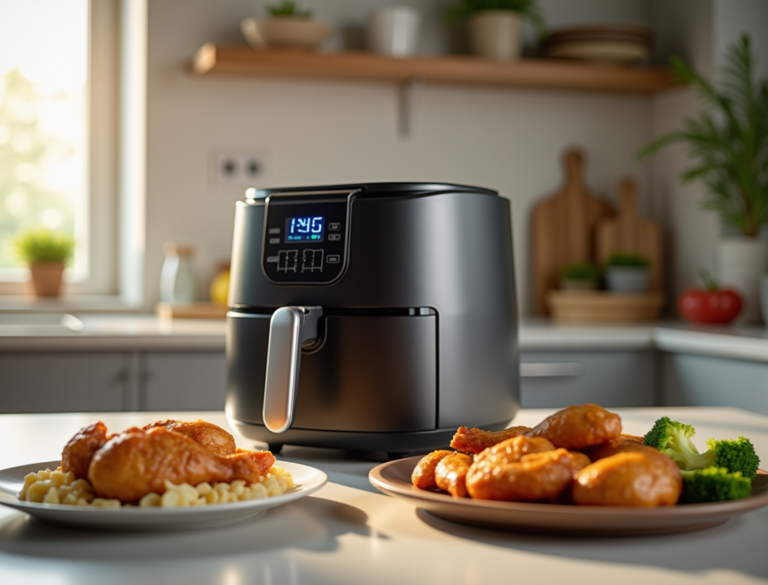
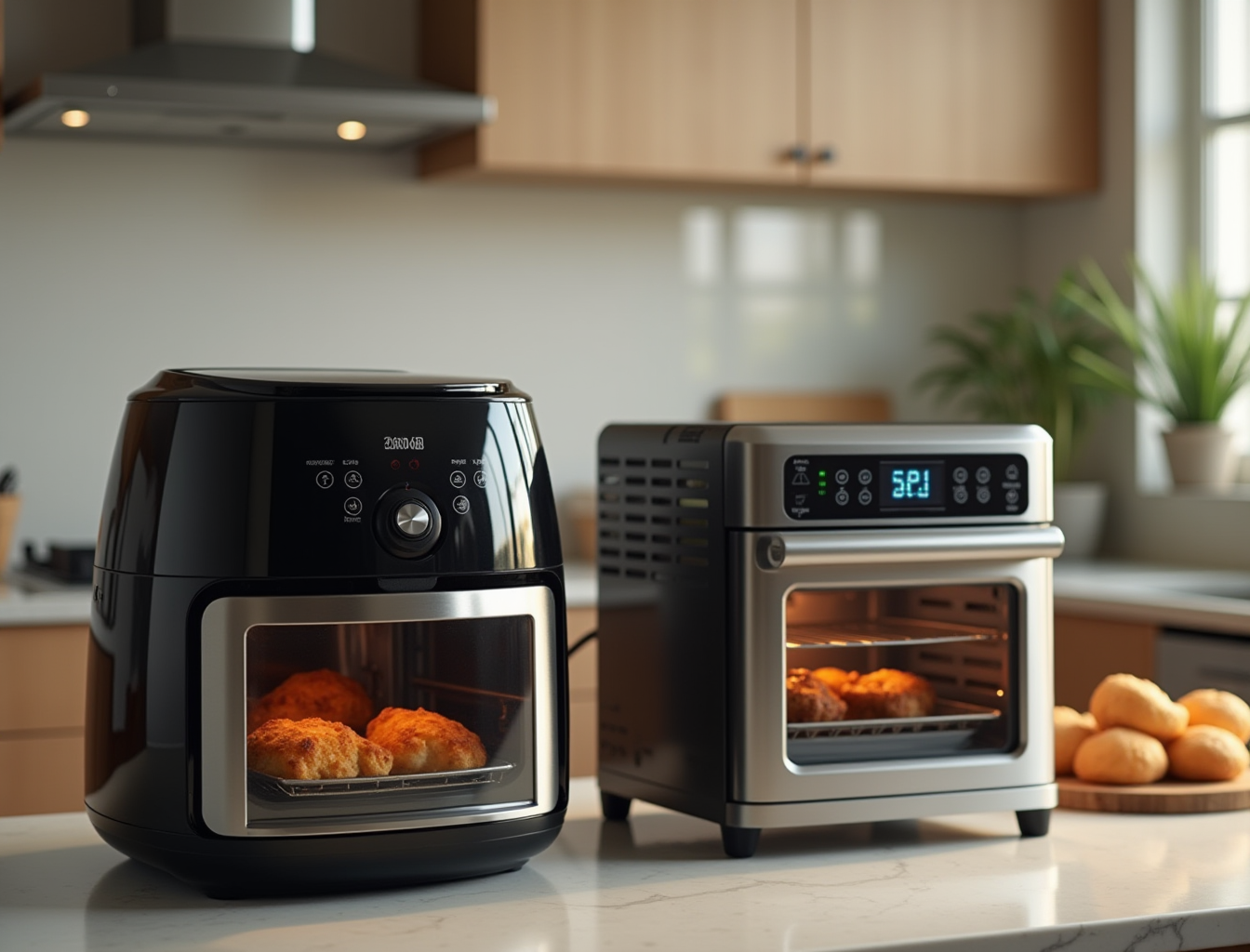
An air fryer is essentially a small, purpose-built countertop appliance that circulates superheated air at very high speed inside a compact, perforated basket. A convection oven — whether a full-size range with a convection setting or a dedicated countertop convection oven — uses a fan to circulate hot air across a much larger interior, typically through a rear-mounted fan and heating element. The core cooking mechanism is identical: moving hot air accelerates heat transfer and moisture evaporation, which is why both appliances produce crispier results than still-air conventional ovens. The meaningful differences come down to size, airflow intensity, preheat time, and cooking capacity.
Whirlpool describes an air fryer as creating “a more intense convection environment” due to its smaller interior and faster fan speed, which concentrates heat more aggressively around food — particularly useful for producing the Maillard browning that mimics deep-frying. A convection oven trades that intensity for volume and versatility, allowing multi-rack cooking, large roasts, and baking tasks that demand more controlled, even heat rather than concentrated blasting.
How Does an Air Fryer Work?
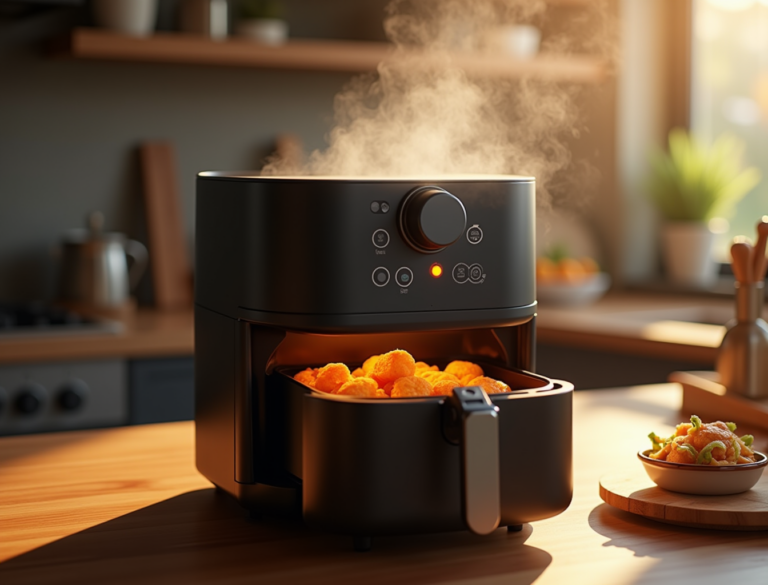
An air fryer uses a heating element positioned above the cooking basket and a high-speed fan that pulls air upward, over the element, then forces it downward and through the perforated basket walls. This creates a cyclonic airflow pattern that wraps every exposed surface of the food in hot air moving at speeds far higher than a standard convection oven achieves. Because the cooking chamber is small — typically 2 to 7 quarts — temperatures stabilize almost instantly. Most air fryers reach operating temperature in 2 to 5 minutes, compared to 10 to 15 minutes for a full-size convection oven. The perforated basket elevates food so rendered fat and moisture drip away rather than pooling around the food, which is the primary reason air-fried foods achieve such dry, crispy surfaces without submersion in oil.
How Does a Convection Oven Work?
A convection oven uses one or more fans — typically rear-mounted, though some models use fans on multiple sides — to continuously circulate air that has been heated by surrounding elements. The fan speed is generally lower than an air fryer’s and the chamber is dramatically larger, which means heat distribution is more uniform across multiple racks. This even, gentle circulation is what makes convection ovens superior for baking: cakes, cookies, and pastries develop even color and structure across the full rack rather than browning unevenly from a single heat direction. Full-size convection ovens typically hold a full sheet pan, multiple casserole dishes, or a whole turkey simultaneously. According to Frigidaire, the convection setting uses the same heating elements as standard baking but adds fan circulation for more even, slightly faster cooking — while a dedicated air fry setting cranks fan speed higher to approximate an air fryer’s intensity.
Air Fryer vs. Convection Oven: Full Comparison Table
| Factor | Air Fryer | Convection Oven |
|---|---|---|
| Cooking Mechanism | High-speed cyclonic airflow, compact chamber | Fan-circulated even heat, large chamber |
| Capacity | 2–7 quarts (1–4 servings typical) | 30–60+ quarts (full family meals, multi-rack) |
| Preheat Time | 2–5 minutes (or none, for some models) | 10–15 minutes for full-size; 5–8 min for countertop |
| Cooking Speed | 20–30% faster than standard oven | 10–20% faster than conventional oven |
| Crispiness | Excellent — rivals deep-frying | Good — better than conventional, less than air fryer |
| Baking Performance | Acceptable for small batches; limited height | Excellent — even heat ideal for cakes, pastries |
| Energy Use (per cook session) | Lower — heats small space, shorter time | Higher — heats large chamber; more efficient for big meals |
| Counter/Space Footprint | Small (countertop) | Large (built-in) or medium (countertop model) |
| Cleanup | Easy — removable basket, often dishwasher-safe | More involved — racks, walls, door |
| Price Range | $30–$250 (standalone) | $150–$2,000+ (range or countertop model) |
| Best For | Wings, fries, reheating, frozen foods, small batches | Roasts, baking, casseroles, large-batch cooking |
What Are the Pros and Cons of an Air Fryer?
Air Fryer Pros
- Speed: The compact chamber means meals are on the table 20–30% faster than a conventional oven and often faster than a full-size convection oven because there is so little air volume to heat.
- Crispiness without oil: The high-velocity airflow replicates deep-frying results using a teaspoon of oil or none at all, reducing fat intake significantly for foods like fries, chicken wings, and breaded items.
- Low energy draw for small meals: Heating a 2–5 quart chamber rather than a 4+ cubic foot oven cavity uses substantially less electricity for single servings or meals for 1–2 people.
- Easy cleanup: Most air fryer baskets and trays are nonstick or dishwasher-safe, making post-meal cleaning a 2-minute task.
- Reheating performance: Reheating pizza, fries, or fried chicken in an air fryer restores crispiness that a microwave destroys. See the complete guide to how to use your air fryer for reheating times.
Air Fryer Cons
- Capacity is the hard limit: Even the largest air fryers max out around 7–10 quarts. Cooking for four or more people requires batching, which adds time and can mean the first batch cools before the second finishes.
- Baking limitations: You cannot bake a full-size cake, pie, or sheet of cookies in a standard air fryer basket. Items that rise (soufflés, tall cakes) are constrained by interior height.
- Not ideal for delicate baking: The blast of hot air can over-brown delicate items like croissants or meringues before the interior sets properly.
- Noise: The high-speed fan is audibly louder than a convection oven — a minor but real consideration in open-plan living spaces.
What Are the Pros and Cons of a Convection Oven?
Convection Oven Pros
- Large capacity: A full-size convection oven can roast a whole turkey, bake four pans of cookies simultaneously, or cook an entire meal in one session.
- Superior baking: Even, controlled airflow produces uniform browning, proper rise, and consistent texture across an entire baking sheet — something air fryers simply cannot replicate at scale.
- Multi-rack cooking: You can cook a protein, vegetable, and starch simultaneously on separate racks.
- Versatility: Broil, bake, roast, proof dough, dehydrate — a convection oven handles tasks that fall outside an air fryer’s wheelhouse.
Convection Oven Cons
- Slow to preheat: Full-size models need 10–15 minutes to reach temperature, which is a meaningful time cost for quick weeknight meals.
- Higher energy draw per session: Heating a large interior to 400°F uses more energy than a compact air fryer for the same small meal — though the gap narrows when cooking large quantities that would require multiple air fryer batches.
- Cleanup: Oven walls, door glass, multiple racks, and drip trays all require periodic scrubbing.
- Less crispy results for fried foods: Even on the highest convection setting, a standard oven cannot match the crunch of a dedicated air fryer for foods like wings and frozen fries.
When Should You Choose an Air Fryer?
An air fryer is the right tool when you need speed, crispiness, and convenience for smaller portions. Specific use cases where an air fryer outperforms:
- Weeknight proteins: Chicken thighs, salmon fillets, and pork chops reach internal temperature and develop a seared crust in 10–20 minutes, with minimal cleanup.
- Frozen foods: Frozen fries, nuggets, tater tots, and fish sticks cook in half the oven time and come out dramatically crispier. See the Air Fryer Cooking Times Chart for frozen food times.
- Reheating leftovers: The air fryer restores crispiness to pizza, fried chicken, and french fries in 3–5 minutes without the sogginess of a microwave.
- Small kitchens and dorm rooms: An air fryer replaces several appliances in a compact footprint.
- Energy-conscious cooking for 1–2 people: The combination of short preheat and fast cook time uses significantly less electricity than running a full-size oven for a single portion.
When Should You Choose a Convection Oven?
A convection oven — whether built-in or countertop — wins when volume, precision baking, or cooking multiple dishes at once is the priority:
- Holiday and family cooking: Roasting a whole chicken, turkey, or large beef roast requires a chamber that can accommodate the size and allow air to circulate around it.
- Baking: Bread, cakes, tarts, and cookies develop correctly in the even, measured heat of a convection oven. The blast from an air fryer browns the exterior too aggressively for most delicate baked goods.
- Casseroles and one-pan meals: A 9×13 baking dish simply does not fit in a standard air fryer basket.
- Multi-dish cooking: Running protein on one rack and vegetables on another simultaneously is a convection oven specialty that no air fryer can replicate.
Common Misconceptions About Air Fryers and Convection Ovens
Myth 1: Air Fryers Are Only for Frying
Despite the name, air fryers bake, roast, grill, dehydrate, and reheat with excellent results. You can make cookies, donuts, roasted vegetables, and even small cakes in an air fryer. The “fry” in the name refers to the oil-free crispiness it achieves, not a limitation on its cooking modes.
Myth 2: Convection Ovens Always Use More Energy
For a small meal, a convection oven uses far more energy because it heats a large chamber for a small amount of food. But for cooking a large roast or multiple trays of food, the convection oven uses less energy per pound of food than running multiple air fryer batches back to back. Energy efficiency depends entirely on how much food you are cooking relative to the appliance’s capacity.
Myth 3: If Your Oven Has a Convection Setting, You Do Not Need an Air Fryer
Many ovens now include an “air fry” setting, which increases fan speed to approximate an air fryer. According to Frigidaire, this setting does narrow the gap meaningfully — but the smaller, more concentrated airflow of a dedicated basket-style air fryer still produces crispier results for small portions because the food is surrounded on all sides by air moving at higher velocity through a much smaller space. If crispiness is your primary goal for small batches, a standalone air fryer still has an edge even over an oven with an air fry mode.
Should You Buy Both, or Choose One?
For most households, the answer is both — used for different tasks. An air fryer excels at fast weeknight meals, crispy snacks, reheating, and frozen foods. A convection oven (your existing oven’s convection setting counts) handles baking, large roasts, and batch cooking. The two appliances are genuinely complementary rather than redundant. If you can only have one: choose an air fryer if you cook small portions frequently and prioritize speed and crispiness. Choose a convection oven if you cook for a larger household, bake regularly, or need the capacity for whole roasts and casseroles. See our guide to the best air fryers if you are ready to add one to your kitchen.
Frequently Asked Questions
Are air fryers healthier than convection ovens?
Both appliances produce results that are healthier than deep-frying, since neither requires oil submersion. Air fryers use slightly less oil to achieve comparable crispiness — typically 1–2 teaspoons versus a tablespoon or more in oven recipes — but the difference in calorie impact is modest. The health advantage of an air fryer comes primarily from replacing deep-frying, not from any meaningful difference compared to convection oven cooking at similar oil levels.
Can I bake a cake in an air fryer?
Yes, but with adjustments. Use a 6-inch cake pan that fits the basket, reduce the temperature by 25°F compared to your oven recipe, and check for doneness 5–10 minutes earlier than the recipe specifies. The concentrated heat browns the exterior faster than a full-size oven. For a full-size layer cake or anything requiring multiple pans simultaneously, a convection oven is the better choice.
Which is more energy-efficient — an air fryer or a convection oven?
An air fryer uses less energy for small meals because its compact chamber heats quickly and the short cook time minimizes total energy draw. A full-size convection oven is more efficient per pound of food when cooking large quantities, because the energy cost of heating its large chamber is distributed across a much larger amount of food. For one to two servings, the air fryer wins on energy. For six or more servings, the oven wins.
Does a convection oven with an “air fry” setting replace a standalone air fryer?
It gets close but does not fully replace a dedicated air fryer for crispiness on small batches. Oven air fry settings increase fan speed and use a perforated tray to improve airflow, but the larger chamber means food is never as completely surrounded by fast-moving hot air as it is inside a compact air fryer basket. For casual air frying with an existing oven that has the setting, the oven is a reasonable alternative. For maximum crispiness, a dedicated basket-style air fryer still has an advantage.
What foods are best cooked in each appliance?
Air fryers excel with chicken wings, fries, frozen snack foods, fish fillets, pork chops, reheated fried foods, and small vegetables. Convection ovens excel with whole roasts, sheet pan dinners, cakes, cookies, bread, casseroles, and any dish that requires a 9×13 pan or larger. Foods that benefit from maximum crispiness on the exterior go to the air fryer; foods that need even heat distribution, controlled browning, or large-capacity cooking go to the convection oven.