Air Fryer Troubleshooting: Fixes for Smoking, Uneven Cooking, Sticking, and More
Quick Diagnostic Table — Find Your Problem Fast
Identify your symptom in the table below, then jump to the relevant section for the full fix.
| Symptom | Most Likely Cause | Quick Fix | Severity |
|---|---|---|---|
| White smoke | Fatty food dripping on heating element | Add 2 tbsp water to bottom drawer | Low — normal |
| Blue or grey smoke | Grease buildup on element from previous cooks | Deep clean the heating element | Medium |
| Black smoke | Food burning or electrical issue | Stop immediately, unplug, inspect | High — do not use |
| Uneven cooking | Overcrowding or no mid-cook shake | Cook in batches, shake halfway | Low |
| Crispy outside, raw inside | Temperature too high | Reduce temp 25°F, extend time 5–10 min | Low |
| Food sticking to basket | No oil or worn non-stick coating | Use parchment liner + light oil spray | Low |
| Plastic smell (new unit) | Manufacturing residue off-gassing | Seasoning run: empty, 400°F, 10–15 min | Low — normal |
| Plastic smell (older unit) | Possible wiring or component damage | Stop use, contact manufacturer support | High — stop using |
| Loud rattling | Loose basket or debris near fan | Check basket seating, clean interior | Low |
| Won’t heat up | Basket not fully inserted | Push basket in firmly until it clicks | Low |
| Trips circuit breaker | Shared circuit overload | Use a dedicated outlet | Medium |
Why Is Your Air Fryer Smoking?
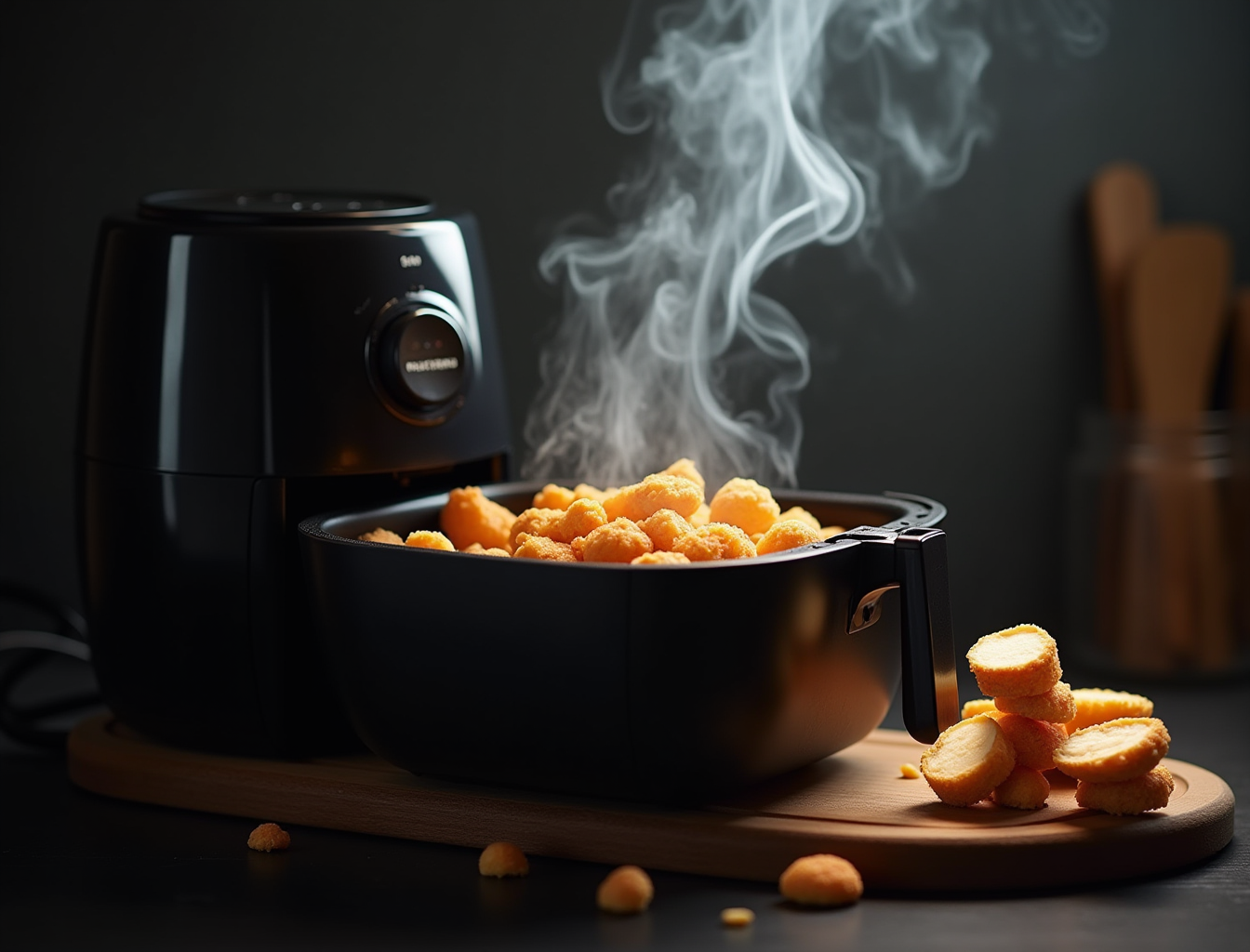
Smoke from an air fryer is the most common and alarming problem new users encounter. The good news: most air fryer smoke is harmless and easy to fix once you know the cause. The key is identifying which type of smoke you’re seeing.
White Smoke vs. Blue or Grey Smoke vs. Black Smoke — What’s the Difference?
White smoke is the most common type and is almost always caused by fat dripping onto the heating element. It’s particularly common when cooking fatty foods like bacon, sausage, chicken thighs, and burgers. White smoke is a nuisance — it can trigger smoke detectors and create cooking odors — but it’s not dangerous. The fix is straightforward (see below).
Blue or grey smoke typically means accumulated grease buildup on the heating element from previous cooking sessions. Unlike white smoke from current drips, blue smoke has a sharper, more acrid smell. It means the element needs cleaning. If your air fryer smokes even when cooking lean foods, this is likely the cause.
Black smoke is the warning sign. Black smoke indicates food is actively burning inside (check for a piece that fell behind the basket) or there is an electrical issue. If you see black smoke, stop cooking immediately, unplug the unit, and do not use it until you’ve identified the source. If it’s an electrical smell, contact the manufacturer — do not attempt to repair it yourself.
Cause 1: Fatty Foods Dripping on the Heating Element
When you cook bacon, sausage, chicken thighs, pork belly, or burgers at high heat, the fat renders out quickly and drips down toward the heating element. The element is hot enough to ignite those fat droplets — producing white smoke. This is the root cause of most air fryer smoke complaints.
Foods that commonly cause smoke: bacon, sausage, chicken thighs (skin-on), chicken wings, pork belly, ground beef patties, lamb chops, and any marinated meat with a sugary sauce.
Cause 2: Grease Buildup from Previous Cooks
Even if you wipe out the basket after each use, grease accumulates inside the drawer (the outer tray that slides out) and occasionally coats the heating element over time. That residue burns at cooking temperatures, which is why regular cleaning your air fryer is essential to prevent smoke and maintain performance.
The Fix: The Water-in-the-Drawer Trick
This is one of the most practical fixes in air frying that most users don’t know about. Before cooking fatty foods, pour 2 tablespoons of water into the bottom drawer (the outer tray, not the basket itself). As hot fat drips down, it falls into the water rather than onto the hot element — the water absorbs the heat of the dripping fat and prevents it from reaching ignition temperature. The result: no smoke, even when cooking bacon at 350°F.
Step by step:
- Remove the basket from the drawer
- Pour 2 tablespoons of water into the bottom of the outer drawer
- Reinsert the basket
- Cook as normal — refill water if the cook takes longer than 20 minutes
A slice of bread placed under the basket (in the drawer) also works — it absorbs dripping fat before it reaches the element. Some users prefer this to water for meats with long cook times.
Cause 3: Food Residue on the Heating Element
Small food particles — breadcrumbs, dry seasoning, herb fragments — can collect near the heating element and burn during cooking. If you see smoke but you’re not cooking fatty food, look up into the cooking chamber at the heating element (when the unit is cool and unplugged) for any visible residue. Use a soft brush or damp cloth to clean it gently.
Cause 4: New Air Fryer Off-Gassing
A new air fryer will produce white smoke or a strong plastic smell during the first few uses. This is manufacturing residue — protective coatings, packaging chemicals, and oils used in the production process burning off. It’s normal, not dangerous, and resolves after the initial burn-in run (running the unit empty at 400°F for 10–15 minutes before first use). If you didn’t do the burn-in run before first use, do it now — in a ventilated area.
Why Is Your Air Fryer Cooking Food Unevenly?
Uneven cooking — crispy on the outside but raw inside, or some pieces done while others lag — is the second most common air fryer problem. Almost every cause is fixable with technique adjustments.
Cause 1: Temperature Too High
Cooking at too-high temperature is the primary cause of “crispy outside, raw inside” results. The exterior surface reaches cooking temperature and forms a crust before the interior heat has time to penetrate. The fix: reduce temperature by 25°F and extend cooking time by 5–10 minutes. Slower, lower-temperature cooking allows heat to penetrate to the center while the exterior doesn’t over-brown.
Cause 2: Food Cut Inconsistently
If you have chicken tenders of varying thickness in the same batch, the thin pieces will be done 5–8 minutes before the thick ones. Uniform cutting is the single most underrated prep step. For chicken, trim pieces to a consistent thickness. For vegetables, cut to similar-sized chunks. A mandoline works well for vegetables; a sharp knife and a measured eye works for proteins.
Cause 3: Basket Overcrowded
Overcrowding is the most common cause of both uneven cooking and food that doesn’t crisp. When pieces are stacked or crowded, hot air can’t reach the surfaces in contact with other food — those surfaces steam instead of crisping. The bottom pieces brown, the top pieces stay soft, and internal cooking is inconsistent throughout. Single layer with visible space between pieces is the rule. If you need to cook more food than fits, use two batches.
Cause 4: Not Shaking or Flipping
Air fryers have concentrated heat near the element, which means one side of your food is consistently receiving more heat than the other. Without a midpoint shake (small foods) or flip (large items), you get one-sided results. Shake or flip once at the halfway point. For longer cooks (chicken thighs at 25+ minutes), shaking or checking twice is better.
Cause 5: Wet Food
Surface moisture on proteins or vegetables creates steam when it hits the hot basket — steam inhibits the Maillard reaction and prevents browning. Pat all proteins thoroughly dry with paper towels before seasoning and loading. For vegetables, spin dry or pat after washing. For marinated meats, shake off excess marinade and blot before loading.
Why Is Food Sticking to the Air Fryer Basket?
Why Non-Stick Coating Wears Out
Air fryer basket non-stick coatings (typically PTFE or ceramic) degrade over time — especially with improper cleaning. Metal utensils, abrasive scrubbers, and harsh detergents all scratch the coating. Once scratched, food sticks to the damaged areas and the problem compounds. Most air fryer baskets should be replaced after 1–2 years of regular use or when the coating shows visible wear.
The Fix: Parchment Liners
Perforated parchment paper liners are the simplest, most effective sticking fix. They’re inexpensive (typically sold in packs of 50–100), and they eliminate sticking entirely for delicate items like fish, salmon, eggs, and anything with a sauce or marinade. Get the size that matches your basket — round or square to fit the bottom. Always have food on top of the parchment before inserting — loose parchment flies up and can touch the heating element.
The Fix: Oil Application
Apply oil directly to the food, not the basket. A light spray of avocado or neutral vegetable oil on the food’s surface provides the barrier needed to prevent sticking. For the basket itself, a light spray before preheating also helps — especially if the coating shows wear. Don’t use aerosol cooking sprays (like PAM) directly on the basket — the propellants can degrade the non-stick coating over time. A separate oil spray bottle with neutral oil is better.
The Fix: Preheat Before Adding Food
Adding food to a cold basket causes it to stick before a crust can form. A preheated basket means food makes contact with a hot surface immediately — the exterior begins to cook and seal before it can bond with the basket material. Three minutes of preheat at your target temperature is enough.
Why Isn’t Your Air Fryer Getting Hot Enough?
Cause 1: Basket Not Fully Inserted
Most air fryers have a safety mechanism that prevents heating unless the basket is fully and firmly seated. If the basket isn’t completely pushed in until it clicks or seats properly, the unit may not activate the heating element. Pull the basket out completely and reinsert with firm pressure.
Cause 2: Overloaded Basket Blocking Airflow
An overfull basket doesn’t just cause uneven cooking — it can reduce the effective temperature inside the cooking chamber by restricting airflow. The thermometer or temperature display reads correctly, but the food itself isn’t experiencing the full temperature because hot air can’t circulate. Reducing the load improves both temperature distribution and cooking results.
Cause 3: Damaged Heating Element
If the unit has never struggled and suddenly takes significantly longer to cook familiar foods, the heating element may be partially failing. Check for any visible damage when the unit is cool and unplugged. If you can’t identify a physical cause, contact manufacturer support — heating element failure is typically covered under warranty.
Why Does Your Air Fryer Smell Like Burning Plastic?
New Air Fryer Off-Gassing (Normal)
A chemical or plastic smell from a new air fryer is expected during the first 3–5 uses. This is manufacturing residue burning off the heating element, interior surfaces, and basket coating. It’s not dangerous, but it’s worth doing the burn-in run before cooking food — run the empty unit at 400°F for 10–15 minutes in a ventilated space to eliminate the smell before it affects your food.
When It’s a Problem
A plastic or electrical burning smell in an air fryer you’ve been using for months is a warning sign. It may indicate melting plastic from something that fell inside the unit, or worse, an issue with the wiring or internal components. Unplug the unit immediately and inspect the interior. If you see melted plastic or can’t identify the source, stop using it and contact the manufacturer. Do not attempt to repair internal electrical components.
Why Is Your Air Fryer Making Loud Noises?
Normal Fan Noise vs. Abnormal Rattling
All air fryers produce fan noise during operation — a steady humming or whirring is completely normal. Rattling, clanking, or irregular sounds are not. Rattling usually means the basket isn’t fully seated or there’s something loose inside the cooking chamber (a small piece of food, a fragment of basket coating, or a displaced rack).
Debris Near the Fan
Fine food particles — breadcrumbs, dried seasoning — can work their way into the fan housing over time and cause noise or vibration. If you hear an unusual sound, let the unit cool completely, unplug it, and look into the top of the cooking chamber (with the basket removed) for any visible debris near the fan. Use a soft brush or compressed air to clear loose particles.
Why Is Your Air Fryer Tripping the Circuit Breaker?
Wattage and Circuit Requirements
Most standard air fryers draw 1,200–1,700 watts. Large oven-style models can draw up to 1,800 watts. This is significant — comparable to a hair dryer or electric kettle. A 15-amp circuit can handle up to about 1,800 watts; a 20-amp circuit handles up to about 2,400 watts. If your air fryer shares a circuit with other high-draw appliances (coffee maker, toaster, microwave), the combined draw can trip the breaker.
The Fix: Dedicated Outlet
Plug your air fryer into its own outlet — ideally on a dedicated circuit. Avoid using extension cords unless they’re rated for the appliance’s wattage. Most power strips and cheap extension cords are not rated for continuous high-wattage appliance use.
Quick Fixes Cheat Sheet
| Problem | Fix | Time Required |
|---|---|---|
| White smoke from fatty food | Add 2 tbsp water to outer drawer | 30 seconds |
| Smoke from grease buildup | Deep clean element and drawer | 15 minutes |
| Crispy outside, raw inside | Lower temp 25°F, extend time 5–10 min | Recipe adjustment |
| Uneven browning | Shake or flip at midpoint | 30 seconds mid-cook |
| Food sticking | Parchment liner + light oil spray | 1 minute prep |
| Won’t heat up | Reinsert basket firmly until seated | 10 seconds |
| New plastic smell | Burn-in run: empty, 400°F, 10–15 min | 15 minutes |
| Trips breaker | Use dedicated outlet, no shared circuits | Immediate |
When Should You Replace Your Air Fryer?
Signs it’s time to replace rather than repair:
- Non-stick coating is visibly flaking or peeling (particles can enter food)
- Electrical or burning smell that doesn’t resolve after cleaning
- Unit takes significantly longer to cook familiar foods (element failing)
- Fan makes grinding or irregular sounds that don’t resolve after cleaning
- Basket handle is cracked or damaged in a way that makes safe use difficult
Most air fryers carry a 1-year manufacturer warranty, some up to 2 years. If your unit is still within warranty and experiencing heating element or electrical issues, contact manufacturer support before replacing — defective units are often replaced at no charge.
Frequently Asked Questions About Air Fryer Problems
Q: Why is my air fryer smoking when I cook bacon?
Bacon is one of the highest-fat foods you can cook in an air fryer. At cooking temperatures, the fat renders quickly and drips toward the heating element, producing white smoke. Fix it by adding 2 tablespoons of water to the bottom drawer before cooking, or place a slice of bread in the drawer to absorb dripping fat. Cook bacon at 350°F rather than higher temperatures to slow fat rendering slightly.
Q: Is it normal for a new air fryer to smoke?
Yes. New air fryers often produce light smoke or a plastic-chemical smell during the first 3–5 uses as manufacturing residue burns off the heating element and interior surfaces. Run the empty unit at 400°F for 10–15 minutes before first use (the burn-in run) to eliminate most of this. Open a window during the burn-in run for ventilation.
Q: Why does my air fryer food burn on the outside but stay raw inside?
Temperature is too high. When you cook at maximum heat, the exterior surface reaches cooking temperature and forms a crust before the center has time to cook through. Reduce your temperature by 25°F and increase cooking time by 5–10 minutes. This is especially common with thick chicken pieces and dense vegetables. See our Air Fryer Conversion Chart for food-specific temperature guidance.
Q: How do I stop my air fryer basket from sticking?
Three steps: (1) preheat the basket 3 minutes before adding food, (2) apply a light spray of oil directly to the food’s surface, and (3) switch to perforated parchment liners for delicate foods like fish, eggs, and anything with a sauce. Avoid metal utensils and abrasive scrubbers that damage the non-stick coating.
Q: Why does my air fryer smell like burning plastic after months of use?
A persistent plastic or electrical burning smell in a unit you’ve been using for months is a warning sign. It may indicate melting plastic from a foreign object inside the unit, or an issue with the wiring or electrical components. Unplug the unit and inspect the interior when cool. If you can’t identify the source, contact the manufacturer — do not continue using it.
More Air Fryer Help
- How to Use an Air Fryer: Beginner’s Guide — Setup, first use, and proper technique
- Air Fryer Conversion Chart — Temperature and time conversions to prevent burning
- 50 Common Air Fryer Questions Answered
- Air Fryer Dehydrator Guide — Dehydrate function troubleshooting included