Air Fryer Dehydrator Guide: How to Dehydrate Food in an Air Fryer (With Recipes)
Can Your Air Fryer Actually Dehydrate Food?
The short answer is yes — but with an important condition. Your air fryer must be capable of reaching temperatures between 95°F and 160°F to properly dehydrate food rather than cook it. Many newer models include a dedicated dehydrate setting, while others let you manually dial down to 120°F or lower. If your air fryer’s minimum temperature is 200°F, it will cook and crisp food rather than slowly remove moisture — you’ll get dried snacks, but with a more cooked texture than true dehydration produces.
The good news: more manufacturers are adding dehydrate modes as a standard feature. If you bought an air fryer in the last two to three years, check your manual or the function buttons for a “dehydrate” or “dehydrator” setting before assuming your model can’t do it.
Air Fryers with Dedicated Dehydrate Settings
The following popular models include a purpose-built dehydrate function with low-temperature control:
- Cosori Pro II (5.8 qt) — Dehydrate mode, 85–175°F range
- Ninja Foodi 6-in-1 — Dehydrate mode, 105–195°F range, multi-rack capable
- Instant Vortex Plus (6 qt) — Dehydrate function, 125–175°F
- Emeril Lagasse French Door — Dehydrate setting, wide rack system
- Gourmia Digital Air Fryer (6 qt) — Dehydrate preset with guided temps
- Chefman TurboFry Oven (6-Slice) — Dehydrate mode, multiple rack positions
What Happens If Your Air Fryer Doesn’t Have a Dehydrate Mode
If your model lacks a dehydrate preset, check your lowest available temperature. If it goes to 170°F or below, you can still dehydrate — results will be slightly more “toasted” in texture, particularly for thin fruits and herbs. Set to the absolute minimum, run in shorter increments, and monitor frequently. For temperatures of 200°F and above, you’re in cooking territory: you’ll get crunchy results (especially for kale chips and zucchini), but the texture and shelf life differ from true low-temperature dehydration.
Air Fryer vs. Dedicated Dehydrator — Honest Comparison
| Factor | Air Fryer with Dehydrate | Dedicated Dehydrator |
|---|---|---|
| Temperature control | Good (many go to 95–130°F) | Excellent (some as low as 85°F) |
| Batch capacity | Small (1–2 trays max) | Large (4–12 trays typical) |
| Speed | Faster (powerful fan) | Slower, more even |
| Even drying | Good with rotation | Excellent |
| Energy efficiency | Less efficient (higher wattage) | More efficient for long runs |
| Versatility | High (fries, bakes, dehydrates) | Dehydrate only |
| Counter space | One appliance, dual purpose | Requires additional space |
Verdict: For occasional dehydrating — jerky a few times a month, fruit chips, herb drying — your air fryer is a capable and convenient option. If you’re making large batches regularly, a dedicated dehydrator handles volume and consistency better. For most home kitchens, the air fryer is the smarter space-conscious choice.
How Does the Dehydrate Function Actually Work?
Dehydration removes moisture from food by exposing it to warm, dry, circulating air over an extended period. Unlike cooking, which applies high heat to trigger chemical reactions quickly, dehydration is slow and low — the goal is evaporation, not the Maillard reaction.
Temperature Range for Dehydrating (95°F–160°F)
Different foods require different temperature ranges to dehydrate safely and effectively:
- Herbs and delicate greens: 95–110°F — low enough to preserve volatile oils and color
- Fruits: 125–140°F — removes moisture while retaining natural sugars and texture
- Vegetables: 125–135°F — achieves crisp texture without over-browning
- Meats (jerky): 155–160°F — the USDA recommends reaching 160°F internal temperature for food safety
Why Airflow Matters More Than Heat
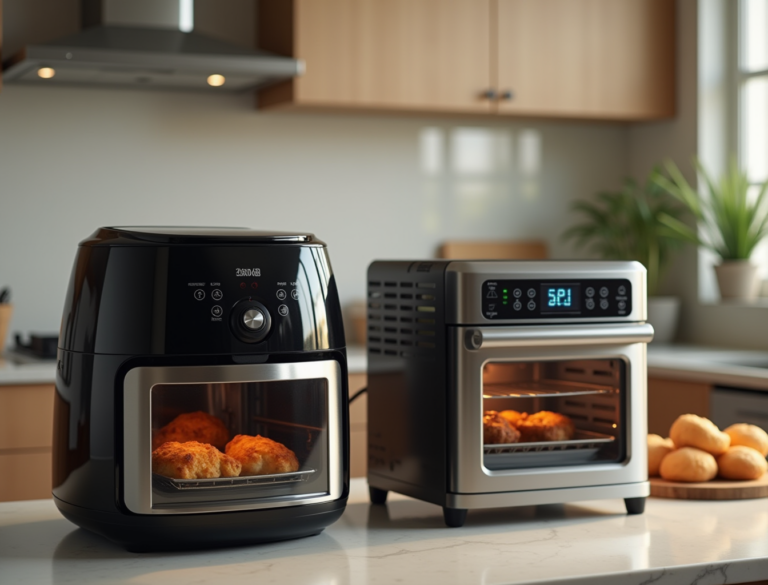
The fan is the most important component in air fryer dehydration — even more than the heating element. Circulating air carries moisture away from the food’s surface, allowing more moisture to migrate from the interior outward. Without strong, consistent airflow, you get uneven results: dry exterior with a still-moist center (called case hardening). This is why oven-style air fryers with multiple rack positions often outperform basket models for dehydrating — the food surface is more exposed on all sides.
Moisture Escape — Why You Need to Leave a Gap
For the dehydration process to work, moisture needs somewhere to go. In oven-style air fryers, moisture escapes through exhaust vents naturally. In basket models, slightly propping or venting the basket can help — some users leave the basket handle extended to allow a small gap at the top. If your model has a “keep warm” or low-convection mode, that also helps. The practical rule: don’t pack food tightly, and never cover the basket with foil during dehydration.
What Is the Master Temperature and Time Chart for Dehydrating?
This reference table covers the most commonly dehydrated foods. All times assume a single layer, uniform thickness, and a model that reaches the listed temperature. Check at the midpoint and test for doneness — air fryer models vary, and food moisture content varies by season and source.
| Food | Thickness | Temp (°F) | Time Range | Doneness Test |
|---|---|---|---|---|
| Beef jerky | ⅛ inch | 160°F | 2–3.5 hrs | Bends without snapping, no moisture when pressed |
| Apple chips | ⅛ inch | 135°F | 3–4 hrs | Crisp, no sticky center |
| Banana chips | ¼ inch | 135°F | 3–5 hrs | Dry, slightly leathery or crisp |
| Mango slices | ¼ inch | 135°F | 4–6 hrs | Pliable, not sticky or moist |
| Strawberry chips | ⅛ inch | 130°F | 3–4 hrs | Crisp, no soft center |
| Zucchini chips | 1/16 inch | 135°F | 3–4 hrs | Crisp, wafer-thin, no flex |
| Kale chips | Whole leaf | 125°F | 1.5–2 hrs | Completely dry and crisp |
| Tomatoes (sun-dried) | ¼ inch | 135°F | 5–7 hrs | Leathery, chewy, no surface moisture |
| Mushrooms | Whole or halved | 125°F | 3–4 hrs | Dry, significantly shrunken, weightless |
| Fresh herbs (rosemary, thyme) | Whole leaf | 95°F | 1–2 hrs | Crumbles easily between fingers |
| Basil | Whole leaf | 95°F | 1–1.5 hrs | Papery, crumbles, no moisture |
| Pineapple rings | ¼ inch | 135°F | 5–8 hrs | Pliable, no surface moisture, chewy |
Pro tip: Times on the shorter end of the range apply to air fryers with powerful fans (like oven-style models). Basket-style models may need the full range. Always check at the midpoint.
How Do You Dehydrate in an Air Fryer Step by Step?
The universal dehydrating process applies across all foods. Follow these steps for consistent results every time.
- Wash and dry produce thoroughly. Pat everything completely dry with paper towels before loading. Surface moisture adds time and can cause uneven results.
- Slice uniformly. Consistent thickness is the single most important prep step. A mandoline slicer produces reliably even slices — especially for apples, zucchini, and banana chips. Inconsistent pieces mean some dry too fast while others stay moist.
- Pre-treat fruits to prevent browning. Dip apple and banana slices in a light lemon juice wash (1 tablespoon lemon juice per cup of water) before loading. This is optional but significantly improves the final color.
- Pre-treat meats for jerky. Marinate beef strips for at least 4 hours (overnight is better). Pat completely dry before loading — wet meat significantly extends dehydration time.
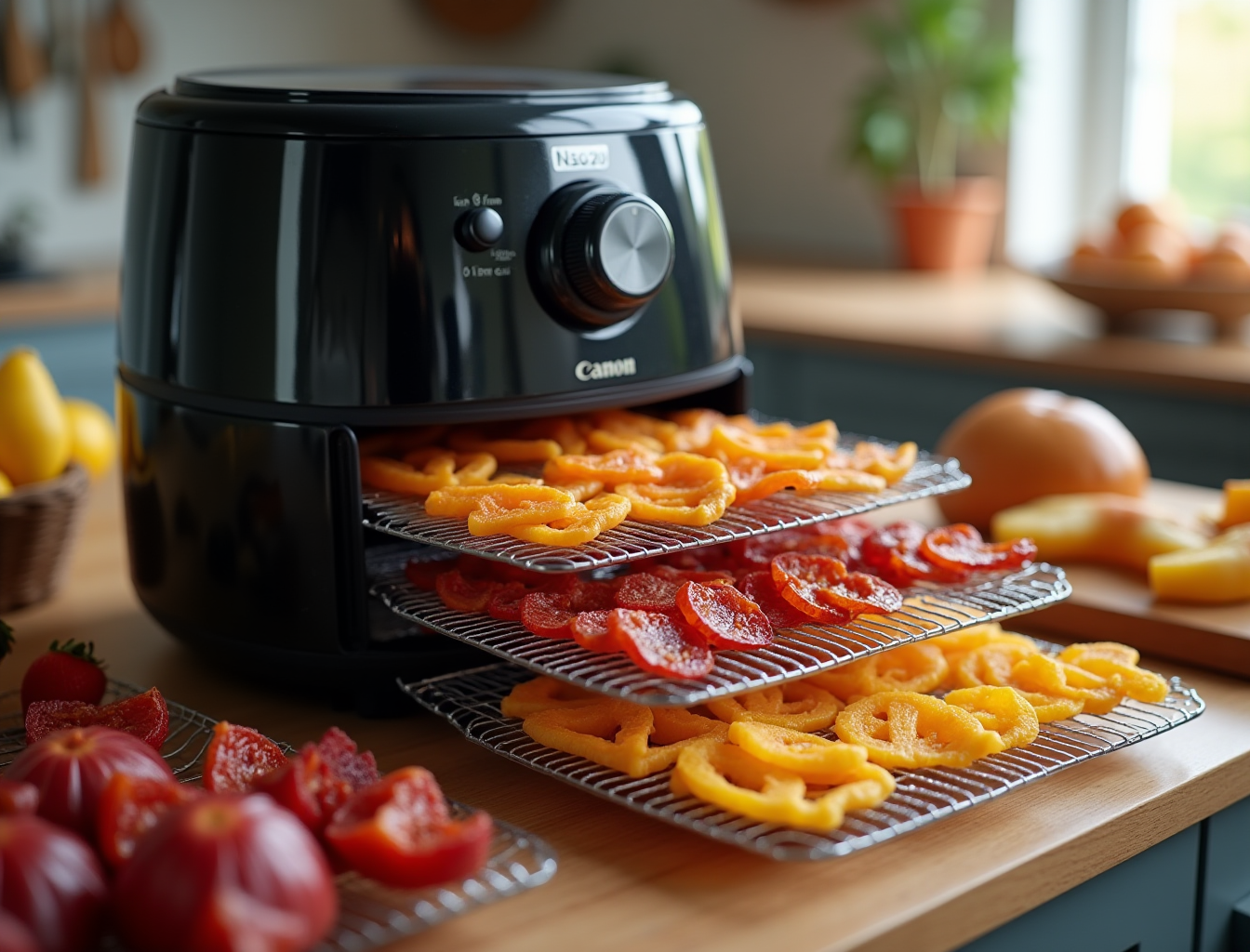
- Arrange in a single layer. No overlapping, no stacking. Leave visible space between pieces. Overlapping is the most common dehydrating mistake and creates soft spots.
- Set to the dehydrate function or lowest available temperature. Use the food-specific temperature from the chart above.
- Prop or vent the basket if needed. For basket-style models without exhaust vents, slightly propping the basket open allows moisture to escape.
- Check and flip at the midpoint. Air fryers have warmer zones near the heating element. Flipping or rotating ensures even results.
- Cool completely before storing. Warm food placed in a sealed container will produce condensation, reintroducing moisture and shortening shelf life.
- Condition before sealing. Place dehydrated food in an open jar for 24 hours before sealing. If you see condensation on the inside, return to the air fryer for another 30–60 minutes.
What Are the Most Common Mistakes When Dehydrating in an Air Fryer?
Overlapping Food (The Biggest Mistake)
Overlapping prevents hot air from reaching food surfaces evenly. The covered surfaces stay moist while the exposed areas dry out — resulting in chewy, inconsistently dehydrated pieces. If you have more food than fits in one layer, dehydrate in batches. It takes more time, but the results are significantly better than trying to rush it with a packed basket.
Setting the Temperature Too High
This causes case hardening — the exterior dries and forms a firm crust while the interior retains moisture. It looks done from the outside but feels soft in the center when you press it. The moisture trapped inside dramatically shortens shelf life. The fix is counterintuitive: use a lower temperature and longer time. Lower heat lets moisture migrate slowly from the center outward without locking it in.
Not Patting Produce Dry First
Surface moisture significantly extends dehydration time. A few minutes of careful patting before loading pays off with faster, more even results. This is especially important for water-rich vegetables like zucchini and tomatoes — pressing them between paper towels and letting them sit 10 minutes before loading makes a measurable difference.
Skipping the Midpoint Flip
Every air fryer has hot spots — areas closer to the heating element that run slightly warmer. Without a midpoint flip or rotation, pieces near the element over-dehydrate while pieces farther away lag behind. A single flip halfway through is all that’s needed.
Storing Before Fully Cooled
Warm dehydrated food placed directly into a sealed container will create condensation on the inside of the container. That moisture reintroduces humidity to the food, softening it and inviting mold. Always let dehydrated foods cool to room temperature on a wire rack before transferring to storage containers — at least 30 minutes.
How Do You Store Dehydrated Foods?
Airtight Container vs. Mason Jar vs. Vacuum Seal
Any of these work, but they differ in how long they preserve your dehydrated food:
- Airtight container (glass or plastic): Good for 2–4 weeks at room temperature; 3–6 months in the fridge
- Mason jar with tight lid: Excellent — glass doesn’t absorb odors; ideal for herbs and small quantities
- Vacuum-sealed bags or jars: Best for long-term storage; extends shelf life 3–5x compared to standard airtight containers
Store all dehydrated foods in a cool, dark location away from direct sunlight. Heat and light accelerate quality degradation even in sealed containers.
Shelf Life by Food Category
| Food Category | Airtight Container | Vacuum Sealed | Notes |
|---|---|---|---|
| Herbs | 6–12 months | 12–18 months | Store whole, crumble before use |
| Fruit chips | 2–4 weeks | 6–12 months | High sugar = faster moisture absorption |
| Vegetables | 3–6 months | 12+ months | Must be fully dry or mold risk |
| Beef jerky | 1–2 months | 6+ months | Refrigerate for safety beyond 2 weeks |
| Mushrooms | 6 months | 12+ months | Excellent dehydrated storage food |
Frequently Asked Questions About Air Fryer Dehydrating
Q: Can I use my air fryer as a dehydrator if it doesn’t have a dehydrate setting?
Yes, as long as your air fryer reaches 170°F or below. Set it to the lowest available temperature and monitor closely. If 200°F is the minimum, you can still make dehydrated-style snacks, but the texture will be more cooked than traditionally dehydrated — think kale chips and zucchini crisps rather than pliable jerky or leathery mango slices.
Q: What temperature do you set an air fryer for dehydrating?
Temperature varies by food. Herbs: 95–110°F. Fruits and vegetables: 125–140°F. Meats: 155–160°F. Using the correct temperature range is critical — too high causes case hardening (crispy outside, moist inside), which traps moisture and reduces shelf life.
Q: How long does it take to dehydrate in an air fryer?
Herbs: 1–2 hours. Thin fruit chips: 3–4 hours. Thicker fruit slices: 4–6 hours. Vegetables: 2–5 hours. Beef jerky: 2–3.5 hours. Actual times vary by model power, food thickness, and initial moisture content. Always check at the midpoint.
Q: Is an air fryer dehydrator as good as a real dehydrator?
For small batches, an air fryer with a proper dehydrate function is comparable in quality to an entry-level dedicated dehydrator. The key limitation is batch size — air fryers typically handle one to two trays worth of food at a time. For high-volume dehydrating, a dedicated unit with 5–10 trays is more practical. For occasional snack-making, your air fryer is more than sufficient.
Q: Can you dehydrate meat in an air fryer for jerky?
Yes. Slice beef against the grain to ⅛ inch thickness, marinate overnight, pat completely dry, and dehydrate at 160°F for 2–3.5 hours. The USDA recommends reaching an internal temperature of 160°F for beef jerky safety. Check with a probe thermometer before removing. See our full Air Fryer Beef Jerky guide for the complete recipe and marinade options.
More Air Fryer Guides
- How to Use an Air Fryer: Complete Beginner’s Guide
- Air Fryer Beef Jerky
- Air Fryer Cooking Times Chart (100+ Foods)
- Air Fryer Conversion Chart: Oven to Air Fryer
- Keto Air Fryer Recipes
- 50 Common Air Fryer Questions Answered