Air Fryer Ribs | Fall-Off-the-Bone Baby Back Ribs in Under 45 Minutes
Yes, you can make legitimately good ribs in the air fryer — not “good for the air fryer” good, but actually good. The method is faster than the oven (under 45 minutes active cook time), produces tender meat, and delivers a sticky BBQ glaze that holds up to the real thing. The key is understanding what the air fryer can and cannot do for ribs — and using it correctly.
This guide covers the complete method: membrane removal, the dry rub formula, cut-to-fit technique, exact temperatures and times, and the two-stage cook (low-and-slow at 375°F, then high-heat glaze at 400°F) that makes the difference between good ribs and great ones.
Can You Really Make Fall-Off-the-Bone Ribs in an Air Fryer?
Mostly yes — with an honest caveat. Air fryer ribs at 30–40 minutes will be tender with a noticeable “tug” — the meat gives cleanly off the bone but does not literally fall. For true fall-off-the-bone texture (internal temperature 195–203°F, where collagen fully converts to gelatin), you need extended low-and-slow heat that a small air fryer basket cannot replicate.
What the air fryer does deliver, which smokers and ovens do not do as conveniently:
- Tender, juicy ribs in under 45 minutes total
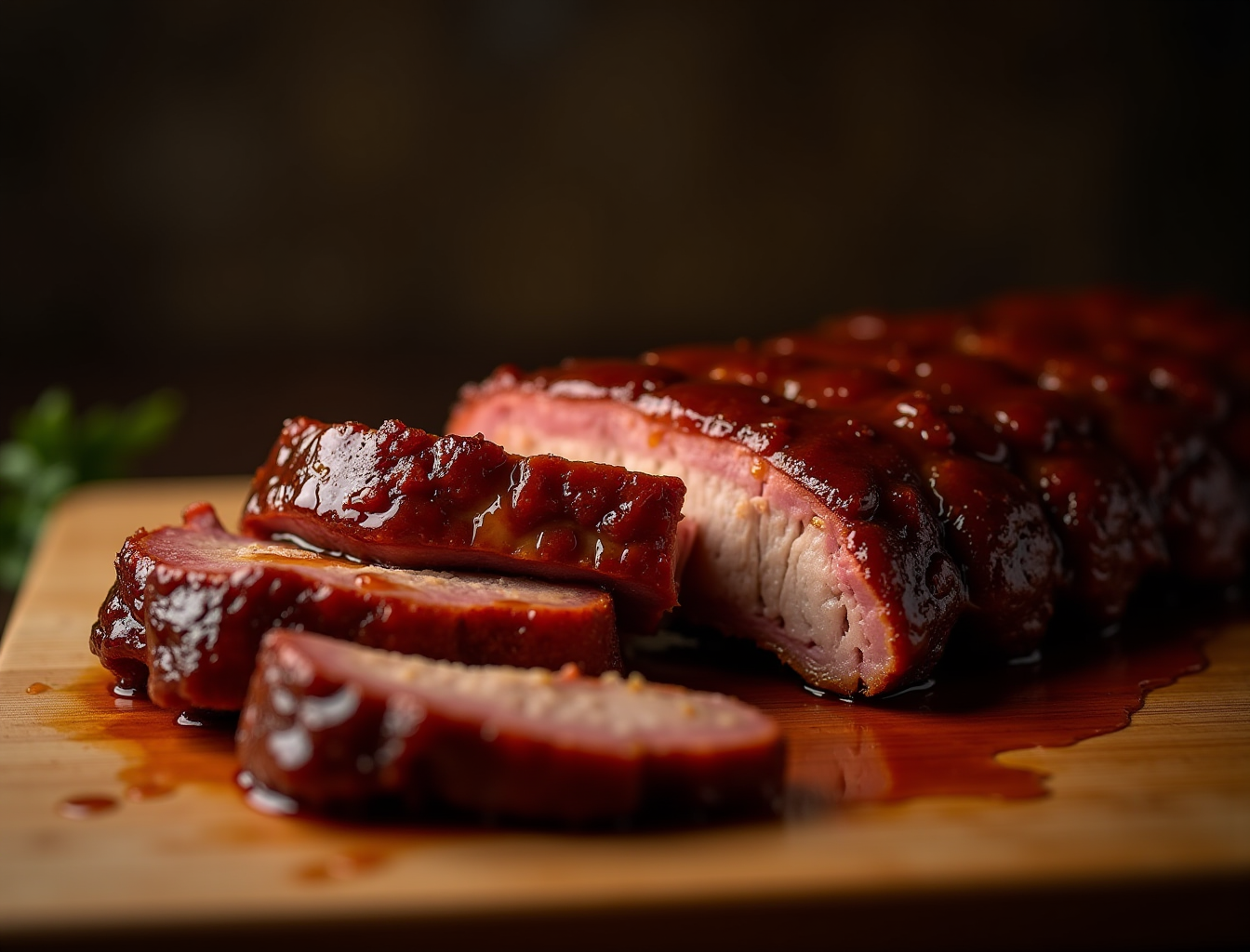
- A caramelized, slightly charred BBQ glaze in the final 5–7 minutes
- Crispy bark on the edges of the dry rub
- No grill required, no oven preheated for hours
The USDA minimum safe internal temperature for pork is 145°F. For ribs to reach the “tender” zone (meat pulling from the bone), target 185–190°F minimum. For fall-off-the-bone texture, target 195–203°F — which the air fryer can achieve with baby back ribs at the times in this guide.
Baby Back Ribs vs. Spare Ribs — Which Works Better in the Air Fryer?
| Rib Type | Size | Fat Content | Air Fryer Fit | Total Cook Time | Best For |
|---|---|---|---|---|---|
| Baby Back Ribs | Shorter, curved | Leaner | Easiest to fit | 30–35 min + 5–7 glaze | Best overall air fryer choice |
| Spare Ribs | Longer, flatter | Fattier | Requires more cutting | 35–40 min + 5–7 glaze | Richer flavor, less tender |
| St. Louis Cut | Trimmed spare ribs | Moderate | Easier than spare ribs to fit | 32–37 min + 5–7 glaze | Good middle-ground option |
| Country Style Ribs | Thick boneless cuts | Higher | No rack to fit | 20–25 min | Different recipe entirely |
Recommendation: baby back ribs. They are leaner (less rendering time needed), shorter and curved (easier to cut to fit the basket), and cook in 30–35 minutes — the sweet spot for air fryer tenderness. Spare ribs and St. Louis cut work but need more time and more aggressive cutting to fit in the basket.
What Ingredients Do You Need for Air Fryer Ribs?
Serves 2–3 | Prep: 15 min | Cook: 35–42 min
The Dry Rub
- 2 tablespoons brown sugar
- 1 tablespoon smoked paprika
- 1 teaspoon garlic powder
- 1 teaspoon onion powder
- 1 teaspoon ground cumin
- 1/2 teaspoon cayenne pepper (reduce to 1/4 tsp for less heat)
- 1 teaspoon kosher salt
- 1/2 teaspoon black pepper
This rub is balanced between sweet (brown sugar), smoky (smoked paprika), savory (garlic, onion, cumin), and heat (cayenne). The brown sugar is crucial — it caramelizes during the final high-heat glaze stage to create the bark. Do not substitute with white sugar, which burns rather than caramelizes at air fryer temperatures.
Everything Else
- 1 rack baby back ribs (approximately 2–2.5 lb), cut in half or thirds to fit basket
- 1/2 cup BBQ sauce of your choice (for the final glaze only)
- Olive oil spray
For the BBQ sauce: any sauce works. A sweet Kansas City-style sauce (like KC Masterpiece) caramelizes beautifully. A vinegar-forward Carolina sauce adds tang. A spicy chipotle sauce adds smoke and heat. Pick what you enjoy — the dry rub and cook method are the same regardless.
How Do You Cook Air Fryer Ribs Step-by-Step?
Do You Need to Wrap Ribs in Foil?
No — and this is a common misconception. Foil wrapping (the “Texas crutch”) is used in oven and smoker methods to trap steam and speed up the stall period. In the air fryer, the sealed cooking chamber and high-velocity hot air circulation create enough of a moist cooking environment on their own. Skip the foil.
Exception: for very thick spare ribs over 2 inches thick, a 15-minute foil wrap at the halfway point can add tenderness. Wrap loosely in foil, return to the basket for 15 minutes, then unwrap for the glaze stage. This is optional even for thick spare ribs — it helps but is not required.
How to Cut Ribs to Fit the Air Fryer
Most air fryer baskets are 5–8 inches across — not wide enough for a full rack. Here is the approach:
- Place the rack bone-side up on a cutting board.
- Count the bones. Cut the rack in half between the 6th and 7th rib (or thirds if needed for smaller baskets).
- Each section should lie flat in the basket without bending or overlapping.
- Do NOT bend the rack to fit — bent ribs cook unevenly and the bent section dries out faster than the rest.
A 5.8 Qt air fryer typically fits a half rack laid flat. A 4 Qt compact may require the rack cut into thirds. The ribs should lie flat in a single layer — they should not touch the heating element above.
Cook Time and Temperature Guide
| Rib Type | Stage 1 Temp | Stage 1 Time | Stage 2 (Glaze) Temp | Stage 2 Time | Target Internal Temp |
|---|---|---|---|---|---|
| Baby Back Ribs | 375°F | 25–30 min | 400°F | 5–7 min | 185–203°F |
| Spare Ribs | 375°F | 35–40 min | 400°F | 5–7 min | 185–203°F |
| St. Louis Cut | 375°F | 30–35 min | 400°F | 5–7 min | 185–203°F |
| Country Style Ribs | 380°F | 20–25 min | N/A | N/A | 145°F (USDA minimum for pork) |
Step-by-step instructions:
- Remove the silver skin membrane. Flip the rack bone-side up. Look for a thin, opaque membrane covering the bones. Slide a butter knife under the membrane at one end to lift a corner, then grip it with a paper towel (for friction) and pull it off in one piece. If it tears, use the knife to lift the next section and pull again. This step is non-negotiable — the membrane acts as a moisture barrier that prevents rub penetration and stays rubbery after cooking regardless of cook time.
- Cut the rack to fit. Cut in half or thirds so each section lies flat in the basket without bending or overlapping.
- Mix the dry rub in a small bowl and coat all surfaces of the ribs generously — top, bottom, and sides.
- Optional: dry brine. Wrap the rubbed ribs in plastic wrap and refrigerate for 1–8 hours (or overnight). This deepens flavor significantly. If cooking immediately, skip to step 5.
- Preheat the air fryer to 375°F for 5 minutes.
- Spray the basket with oil and place the ribs meaty-side down.
- Cook at 375°F for 25–30 minutes (baby back ribs). Flip once at the 15-minute mark.
- Check internal temperature. A thermometer inserted between two bones (not touching bone) should read 185–190°F minimum at this stage. If under 185°F, continue at 375°F for 5-minute increments until it reaches temperature.
- Brush BBQ sauce on both sides and cook at 400°F for 5–7 minutes. Watch carefully — the sugar in the BBQ sauce can go from caramelized to burnt quickly at 400°F. At the 5-minute mark, open and check the glaze. Pull when it is sticky, slightly dark, and caramelized.
- Rest 5 minutes on a cutting board before cutting into individual ribs. This allows juices to redistribute and makes cutting cleaner.
What Are the Pro Tips for the Best Air Fryer Ribs?
- Remove the membrane — this is the single most impactful step. No amount of cook time or seasoning overcomes an intact silver skin membrane. It stays chewy, repels the rub, and blocks the steam from penetrating the meat. Paper towel grip is the easiest removal method.
- Cut the rack to fit rather than bending it. A bent rack will have an uneven cooked zone at the bend — overcooked on the outside of the bend, underdone on the inside. Two flat half-racks cook evenly every time.
- The BBQ glaze goes on in the last 5–7 minutes only. Applied earlier, the sugar burns before the ribs are cooked through. Applied in the final stage at 400°F, it caramelizes perfectly without burning.
- Use a meat thermometer — time alone is not reliable. Air fryer models vary in power output. A thermometer reading of 190°F tells you the ribs are tender; a timer reading of 30 minutes does not, because rib thickness, basket fullness, and air fryer model all affect actual cook time. The USDA safe minimum for pork is 145°F, but ribs at 145°F are tough. Target 185–203°F for the texture you are after.
- Rest before cutting. Cutting immediately after cooking releases the accumulated juices onto the cutting board. Five minutes of rest keeps them in the meat. Cover loosely with foil during the rest.
What Are the Best Air Fryer Ribs Variations?
Honey Garlic Glaze
Replace the BBQ sauce with a honey garlic glaze: combine 3 tablespoons honey, 2 tablespoons low-sodium soy sauce, 1 tablespoon minced garlic, and 1 teaspoon sesame oil. Brush on in the final 5–7 minutes at 400°F as described above. Garnish with sesame seeds and sliced scallion after resting. This variation pairs well with the dry rub’s smoky-sweet profile and produces a glaze that is slightly less sweet and more complex than standard BBQ sauce.
Memphis Dry Rub (No Sauce)
Skip the BBQ sauce entirely. After stage 1 (375°F, 25–30 minutes), increase to 400°F for the final 8–10 minutes instead of 5–7 minutes. The extra time at high heat develops a dry, cracked bark on the rub rather than a glossy glaze. This is the authentic Memphis competition style — the bark is the feature. The brown sugar in the rub still caramelizes; without the wet sauce, the result is chewier and more intensely spiced.
Ninja Foodi TenderCrisp Method
For Ninja Foodi owners: pressure cook the rubbed ribs with 1 cup of water at high pressure for 20–25 minutes. Quick-release. Drain liquid. Brush with BBQ sauce. Air crisp at 400°F for 8–10 minutes. This produces the most consistently fall-off-the-bone result of any method in this guide — the pressure step softens the collagen in a way the air fryer alone cannot match. See: Ninja Foodi Recipes — TenderCrisp Ribs.
What Should You Serve With Air Fryer Ribs?
Classic BBQ sides that pair naturally with air fryer ribs — and that you can also make in the air fryer:
- Air Fryer Corn on the Cob — charred kernels at 400°F in 10–12 minutes
- Air Fryer Baked Potato — crispy skin, fluffy interior in 35–40 minutes at 400°F
- Air Fryer Brussels Sprouts — the bitter-savory contrast cuts through the richness of the ribs
- Coleslaw — no cooking required; creamy or vinegar-dressed, it provides textural and temperature contrast to the hot, rich ribs
For timing: start the baked potato first (it takes 35–40 minutes), then add the ribs once the potato is halfway done. The corn and Brussels sprouts take 10–15 minutes — start them after the ribs come out and are resting.
Storage and Reheating
Refrigerate: Store cooked ribs in an airtight container for up to 4 days. Individual rib sections store better than a half-rack because they fit more efficiently in containers.
Reheat: Reheat at 375°F for 5–8 minutes in the air fryer. Apply a thin layer of fresh BBQ sauce before reheating — this refreshes the glaze and adds moisture. Reheating from cold (refrigerator) takes the full 8 minutes; from room temperature, 5 minutes is sufficient. Do not microwave — it steams the ribs and makes the bark soft and rubbery.
Freeze: Cooked ribs freeze well for up to 3 months. Wrap individual sections in plastic wrap, then place in a zip-top freezer bag with as much air removed as possible. Thaw overnight in the refrigerator before reheating in the air fryer.
Frequently Asked Questions
How long do you cook ribs in the air fryer?
Baby back ribs take 25–30 minutes at 375°F, plus 5–7 minutes at 400°F with BBQ sauce (total: 30–37 minutes). Spare ribs take 35–40 minutes at 375°F plus the same 5–7 minute glaze stage (total: 40–47 minutes). Always verify internal temperature with a meat thermometer — 185–190°F for tender ribs that hold to the bone; 195–203°F for the most tender, near-fall-off-the-bone texture. The USDA minimum safe temperature for pork is 145°F, but ribs at that temperature will be tough.
Do air fryer ribs need to be wrapped in foil?
No — foil wrapping is not required in the air fryer unlike oven and smoker methods. The air fryer’s sealed cooking chamber and circulating hot air create enough moisture retention on their own. The main purpose of foil in conventional rib cooking (the “Texas crutch”) is to push through the stall — the temperature plateau where evaporation cools the meat. Air fryers do not have this problem because of their compact, sealed environment. For very thick spare ribs, an optional 15-minute foil wrap at the halfway point can add tenderness, but it is not necessary for baby back ribs.
What type of ribs are best for the air fryer?
Baby back ribs are the best choice for the air fryer for three reasons: they are shorter and curved (easier to cut to fit the basket), leaner (less rendering time required), and cook faster (25–30 minutes vs. 35–40 for spare ribs). St. Louis cut ribs are a solid second option — they are spare ribs with the brisket bone removed, making them flatter and slightly easier to fit. Spare ribs work but are the most challenging in terms of fit and cook time.
Why are my air fryer ribs tough?
The most common causes: (1) the silver skin membrane was not removed — it physically prevents tenderness by blocking heat and rub penetration; (2) the ribs were not cooked long enough — pull at internal temperature, not just time; tough ribs are usually under 185°F internal; (3) the ribs were too thick (spare ribs) for the available cook time — add 8–10 minutes to the Stage 1 time and verify internal temperature before glazing.
Can you make air fryer ribs without BBQ sauce?
Yes — the Memphis dry rub variation (described above in Variations) skips the BBQ sauce entirely and extends the high-heat finish stage to develop a dry bark instead. You can also finish with alternatives: hot honey (sweet and spicy), teriyaki sauce, Korean gochujang glaze, or simply nothing at all — the dry rub is complete on its own. The glaze stage at 400°F is specifically for the sauce; without sauce, extend the dry finish at 400°F for 8–10 minutes rather than 5–7.
Sources
- USDA Food Safety and Inspection Service: Safe internal temperature for pork — 145°F minimum; for fall-off-the-bone rib texture, collagen converts to gelatin at 195–203°F
- ThermoWorks: Are Your Ribs Done? How Do You Know?
- Carnivore Style: Pork Ribs Internal Temperature Chart
- My Forking Life: Easy BBQ Air Fryer Ribs
- A Spicy Perspective: Air Fryer Ribs (Easy!)